
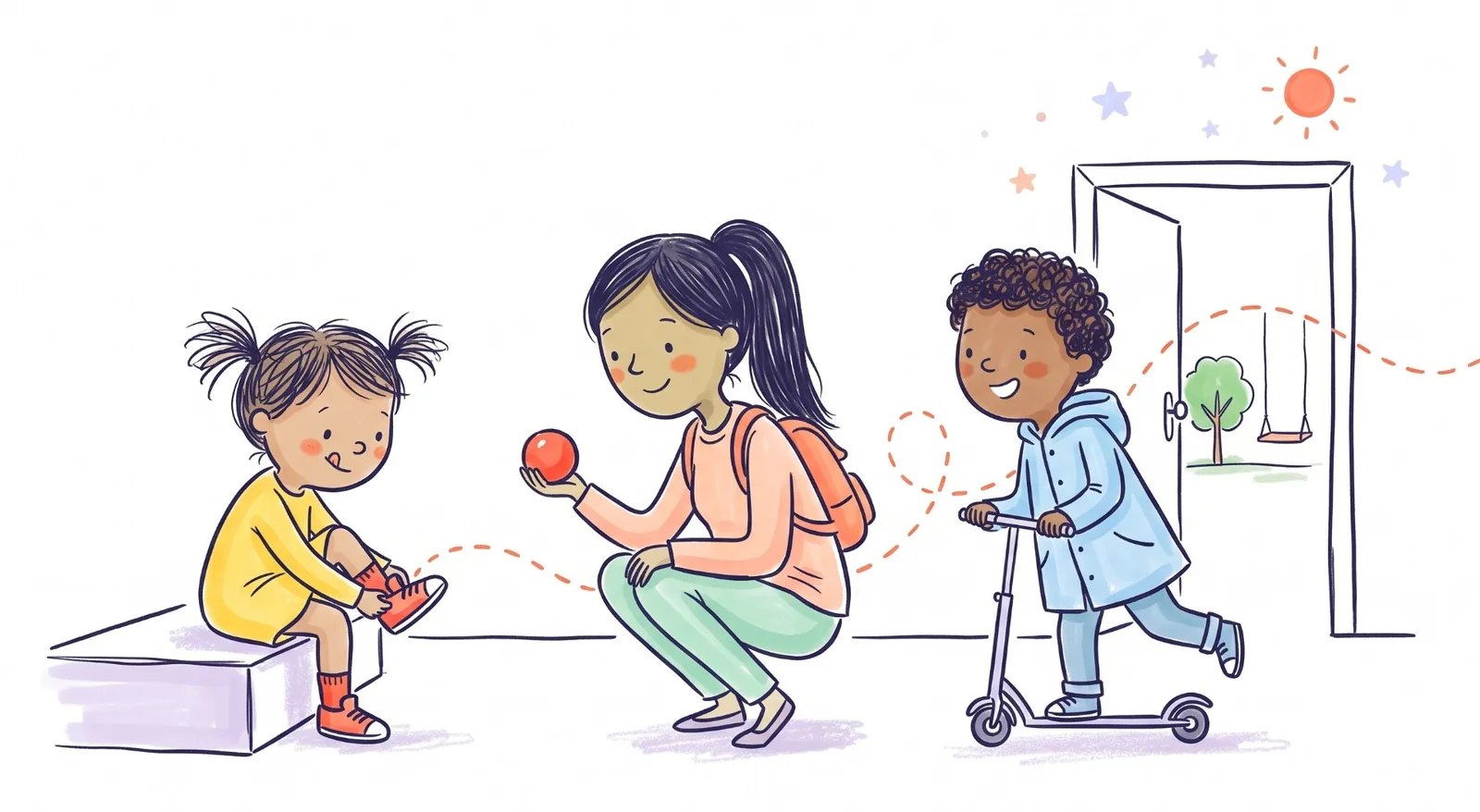
A when-then statement puts the thing your child has to do first and the thing they want second: "When your shoes are on, then we'll go to the park." It's a promise about the order of events, said calmly, before anything has gone wrong. You keep it by actually waiting for the shoes, and by actually going to the park once they're on.
It sounds almost too simple to need a name. The reason it works, and the reason it sometimes doesn't, is in how it's said and when.
Why the order of the words matters
Compare these two:
- "If you don't put your shoes on, we're not going to the park."
- "When your shoes are on, we'll go to the park."
The rule is the same in both. The first is a threat, and it invites a fight about whether you mean it. The second is just a fact about what happens next. Understood.org draws the line in a useful place: when-then is for heading a problem off, if-then is usually how we react once it's started (Understood).
The American Academy of Pediatrics gives an example in its advice on communicating with children who have ADHD ("When you finish your homework, then you can go play baseball") and says the same style can help all the children in a family (HealthyChildren.org). The Vanderbilt Kennedy Center's parenting tip sheets use it the same way, with shoes and going outside (Vanderbilt Kennedy Center).
Where the idea comes from
In 1959 the psychologist David Premack published the idea that an activity a person is more likely to choose can be used to reinforce one they're less likely to choose (Premack, Psychological Review, 1959). By 1963, researchers were testing it with nursery school children (Homme et al., Journal of the Experimental Analysis of Behavior). Teachers and therapists have used it ever since, often under the name "first-then".
You don't need any of that to use it. It does explain why the "then" has to be something your child genuinely wants, rather than something you'd like them to want.
The moments it fits best
Most of the friction in a family day happens at a handover: stopping one thing and starting another. The Child Mind Institute says being asked to stop one thing and start another is a very common trigger for problem behaviour in children (Child Mind Institute). Those are the moments where when-then is most useful.
| Moment | When... | ...then |
|---|---|---|
| Leaving the house | When your shoes and coat are on | we'll get in the car and put your song on |
| Getting in the car at pickup | When your seatbelt clicks | you can have the snack in my bag |
| Arriving home | When your lunchbox is on the counter | you can play until dinner |
| Homework | When the reading log is signed | you can go outside |
| Leaving the playground | When we're at the gate | you can pick which way we walk home |
| Bedtime | When your teeth are brushed | we'll read two books |
The "then" doesn't have to be a treat. Some of the best ones are things that were going to happen anyway: the song in the car, the choice of route, the story. Children mostly want to know that the good part is still coming.
How to say it so it holds
Say it once, before the fight. At the door, not ten minutes into a standoff over shoes. Understood.org recommends a calm, confident tone, and it matters more than the exact words.
One "when" at a time. "When your shoes are on, and your coat, and you've been to the bathroom, and found your hat" is four jobs. The CDC's advice on giving directions is to give one at a time, especially to toddlers and preschoolers (CDC).
Then wait. This is the part that takes nerve. Don't repeat it every thirty seconds. Stand by the door. The shoes either go on or they don't, and the park either happens or it doesn't.
Deliver the "then" straight away. Shoes on, out the door, no extra conditions added at the last second. If the reward keeps moving, a child learns that the sentence doesn't mean much. The CDC also suggests praising them when they follow a direction, so "Shoes on, thank you. Let's go" is the whole speech.
A warning helps, but it isn't enough on its own. Zero to Three mentions that some parents use a timer or a five-minute warning to make transitions easier (Zero to Three). A small 2005 study with three toddlers found that a two-minute warning on its own got almost nowhere when it was time to stop playing and go to the potty, and neither did letting them bring a toy along. Things changed when the adults followed through on the instruction every time, guiding the child if they didn't start moving (Cote, Thompson and McKerchar, Journal of Applied Behavior Analysis). Warn them, then hold to the when-then.
Is it bribery?
A bribe is offered in the middle of a meltdown to make it stop: "OK, OK, you can have a cookie if you just put your shoes on." The child learns that the meltdown is what produced the cookie.
A when-then is set up before anything has gone wrong, for something that was part of the day anyway, and it doesn't get bigger when they protest. If your child screams about the shoes, the answer is still "When your shoes are on, we'll go," said just as calmly. No second offer, no extra snack.
When it doesn't work
- The "then" isn't something they want. "When your homework's done, then you can do your chores" won't move anybody.
- They're already past the point of listening. A tired, hungry kid at 3:30 has nothing left for a deal. Give the snack first, no strings attached, and save the when-then for the next transition. Some kids hold it together all day at school and fall apart in the car. That needs comfort, not terms.
- The adult gives in. If "when" becomes "OK, fine, we'll go anyway" often enough, the sentence stops meaning anything.
- Different adults, different rules. If you hold the line on seatbelts before snacks and the sitter hands the snack over at the school gate, your child learns that the rule only applies to you.
Getting everyone to say the same thing
That last one is where most families come unstuck, because the moments that need a when-then are often the ones you aren't there for: the pickup, the drive home, the hour before dinner. Grandma, the sitter and the other parent all handle transitions too, each in their own way.
Kid Pickup can't make anyone consistent, but it does put everyone who does pickups in one place. The family chat, on every plan, includes everybody you've invited, so one message reaches all of them: "We're doing 'when your seatbelt's on, then snack' this week. The snack's in the front pocket of her backpack." Every pickup shows whose it is, so you know who'll be in the car that afternoon and who needs to hear the plan. And the family gets a notification when the pickup's done, so you know they're on their way home.
It works well alongside giving two choices ("When we're home, you can have crackers or an apple") and a clear first ask. For the moments when it's you who needs to calm down first, there's three things to tell yourself before you react. Kid Pickup is free to try for two weeks on iPhone for new subscribers, and grandparents and sitters don't pay.
FAQ
What is a when-then statement?
A when-then statement tells a child that once they've done a less-wanted task, a more-wanted one will follow: "When your teeth are brushed, then we'll read." It's said calmly before a problem starts, and the adult follows through as soon as the task is done.
What's the difference between when-then and if-then?
The rule can be the same, but the tone differs. "If you don't..., then you can't..." sounds like a threat and is usually used once a problem has started. "When you..., then we'll..." states the order of events and is used to prevent one.
Is a when-then statement a bribe?
No. A bribe is offered during a meltdown to stop it, so the child learns the meltdown worked. A when-then is set before anything goes wrong, usually uses something that was going to happen anyway, and doesn't grow when the child protests.
What age can you start using when-then statements?
Toddlers can follow a simple one-step when-then, especially with a picture or a gesture, and the phrasing works through the school years. Keep the "when" to one task for younger children, and deliver the "then" straight away.
Is first-then the same as when-then?
Yes, broadly. "First shoes, then park" is the same idea in fewer words, and it's common in classrooms and with younger children. Both put the less-wanted task first and the more-wanted one second.