
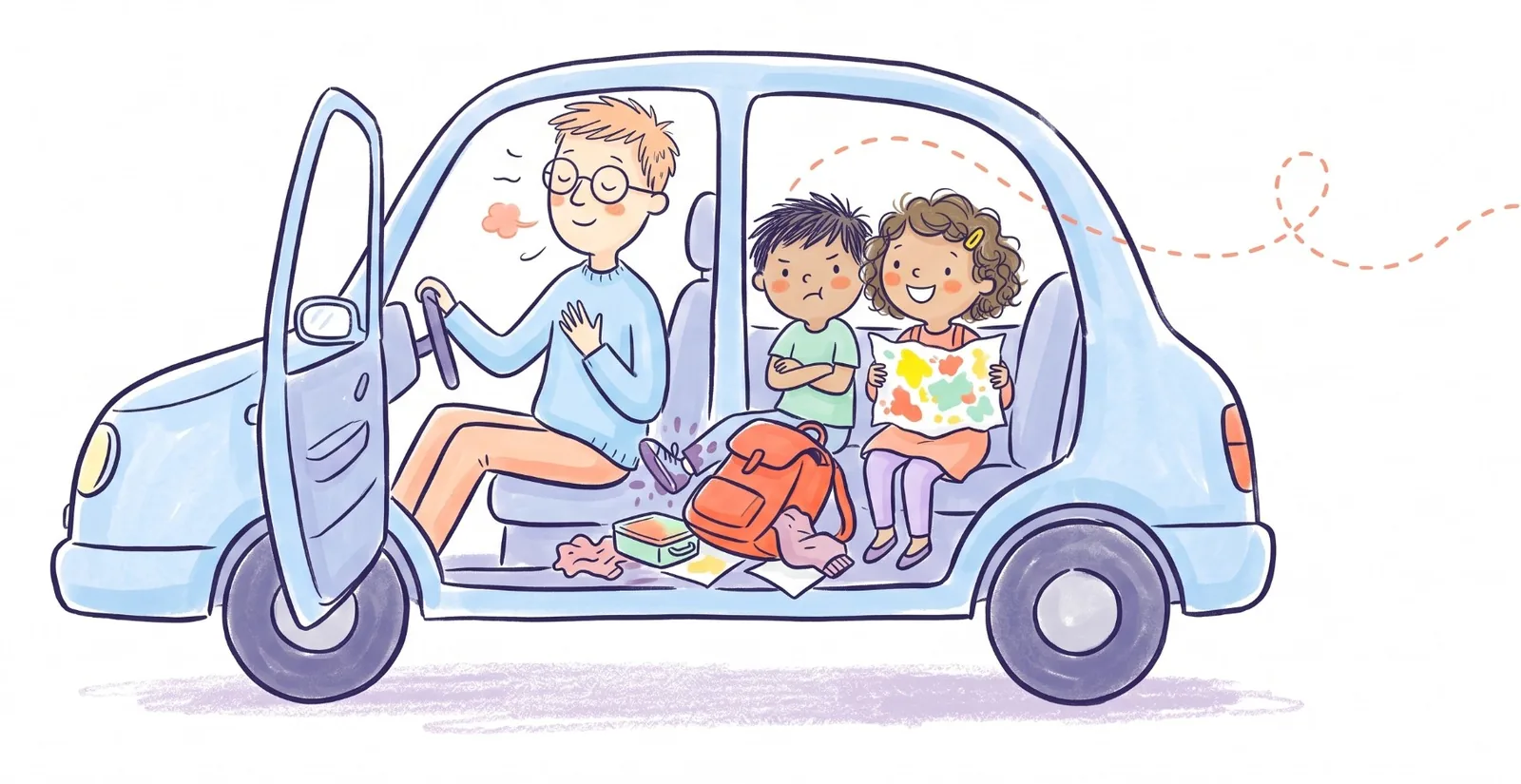
It's 3:20. You're in the car line, ten minutes late because a meeting ran over, and the backpack that comes through the door is missing a lunch box, a sweater and, by the sound of it, any interest in being kind to a younger brother. Somebody kicks the back of your seat. Your shoulders are already up around your ears.
Most of the moments we regret as parents start like this. Not with a big decision, but with a small one made in about half a second, while we're tired, late and running on what's left.
What you say to yourself in that half-second decides a lot of what you say out loud.
Here are three sentences worth having ready, why they work, and what to do on the days they don't.
Why a sentence in your head helps
Putting a feeling into words calms it down. In a 2007 brain-imaging study at UCLA, people who labelled an upsetting image with a word for the feeling ("angry", "scared") showed less activity in the amygdala, the brain's alarm system, than people who looked at the same image without naming it (Lieberman et al., Psychological Science). Naming what's going on, even silently, gives the thinking part of your brain a moment to catch up.
That moment matters because the alternative doesn't work very well. The American Academy of Pediatrics warns that yelling at or shaming a child can raise stress hormones, and that harsh verbal punishment may make a child fearful in the short term but doesn't improve behaviour over the long term (AAP, 2018). A University of Pittsburgh study that followed nearly a thousand families found that harsh verbal discipline at 13 predicted more conduct problems and depressive symptoms over the next year, and that a warm relationship didn't cancel it out (Wang & Kenny, Child Development).
None of that means you're doing it wrong if you've raised your voice this week. Every parent has. It means the half-second is worth practising.
1. "This isn't an emergency."
Almost nothing that happens at 3:20 needs an answer in the next three seconds. The lunch box can be found tomorrow. The seat-kicking can stop after you've breathed out.
Saying "this isn't an emergency" to yourself does two things. It tells your body to stand down, and it gives you permission to wait. Take one slow breath and name what you're feeling: "I'm frustrated," "I'm embarrassed," "I'm worn out." That's the labelling the UCLA study found turns the alarm down.
The exception is real danger. A child running toward the road gets a loud, fast "Stop!" every time. That isn't reacting; it's your job. Everything else can wait for one breath.
2. "They're having a hard time, not giving me a hard time."
When a child melts down, it's easy to read it as a choice: they're doing this on purpose, they're testing you, they don't care. Psychologist Ross Greene, author of The Explosive Child, puts it another way: "Kids do well if they can" (Lives in the Balance). When they don't, it's usually because a skill is missing, like handling disappointment or switching from one thing to the next, not because they want to make your afternoon worse.
The story you tell yourself matters as much as what actually happened. A 2006 study of mothers of young children found that the way they interpreted everyday hassles predicted their stress better than how often the hassles happened or how big they were (Mazur, Cognitive Therapy and Research, 2006). "He's doing this to me" and "he's had a long day and he's hungry" are the same kick to the back of the seat, and they lead to very different words.
A tired, hungry child at the end of a school day is having a hard time. So, quite often, is the parent picking them up.
3. "What do I want them to learn?"
Discipline means teaching. The Canadian Paediatric Society says it plainly: the goal of discipline is "to guide and teach, not to punish" (Caring for Kids).
So before you answer, ask what you'd like your child to know when this is over. That their brother isn't a punching bag? That we check our bags before we leave school? That they can be upset and still use a quiet voice? Each of those has a calm, specific way to say it ("Feet on the floor, please." "We'll find your lunch box tomorrow." "Use a quiet voice and tell me what happened.").
And some lessons are for later. A child in the middle of a meltdown isn't learning anything except that you're upset too. The teaching usually goes better at bedtime, or on the drive the next morning, when everyone's calm.
When you react anyway
You will. Some days the half-second wins. What happens next counts for more than you'd think.
People who study parents and children call it rupture and repair: being out of step with your child is normal, and what builds trust is coming back to them afterwards (Brazelton Centre UK). A good repair is short and doesn't make your child responsible for your feelings:
I'm sorry I yelled in the car. I was stressed about being late, and that wasn't your fault. Can we start again?
Then start again. That apology teaches the thing you were hoping to teach in the first place: you can lose your cool and still come back.
Take the logistics off the list
Look at when the half-second usually goes wrong, and a pattern shows up. It's rarely the big conversations. It's the rushed in-between times: the school run, the late pickup, the text at 2:58 asking who's getting her today, the realisation in the car line that you thought your partner had soccer.
You can't remove every stressful moment, but you can take some of the guessing out of the afternoon. That's what Kid Pickup is for:
- Every pickup gets a name. Post the pickup, and Grandma, the other parent or the sitter taps "I'll do it". Nobody has to wonder who's going.
- The app sends a nudge when nobody has it, the day before, three hours before and two hours before, while there's still time to sort it out calmly.
- The person doing it gets a reminder before they leave, at the time you choose.
- The family's updates live in one place, on a private feed for your family, instead of a group chat where "running late" scrolls away.
It won't stop a meltdown in the back seat. But a parent who isn't also wondering who's getting the other child has a little more room for that half-second. Kid Pickup is on iPhone with a 14-day free trial, and grandparents and sitters never pay.
FAQ
What should I tell myself before reacting to my child?
Three sentences help most parents: "This isn't an emergency," to buy a breath; "They're having a hard time, not giving me a hard time," to change the story you're telling; and "What do I want them to learn?", to turn the moment into teaching instead of punishing.
How do I stop yelling at my kids?
Start with the pause: one slow breath, and name what you're feeling in your head. Then answer with a calm, specific request instead of a reaction. Notice when you yell most, often rushed transitions like mornings and pickups, and take some of the pressure off those times.
Is it bad to yell at your kids once in a while?
Every parent raises their voice sometimes. Research does link frequent harsh verbal discipline with more behaviour problems and low mood in teenagers, and the American Academy of Pediatrics says harsh verbal punishment doesn't improve behaviour over the long term. What matters most is the pattern, and what you do afterwards.
What should I do after I yell at my child?
Repair it. Once you're both calm, say sorry briefly, name what happened without blaming your child, and start again. Coming back after a rough moment is part of how children learn to trust you.