
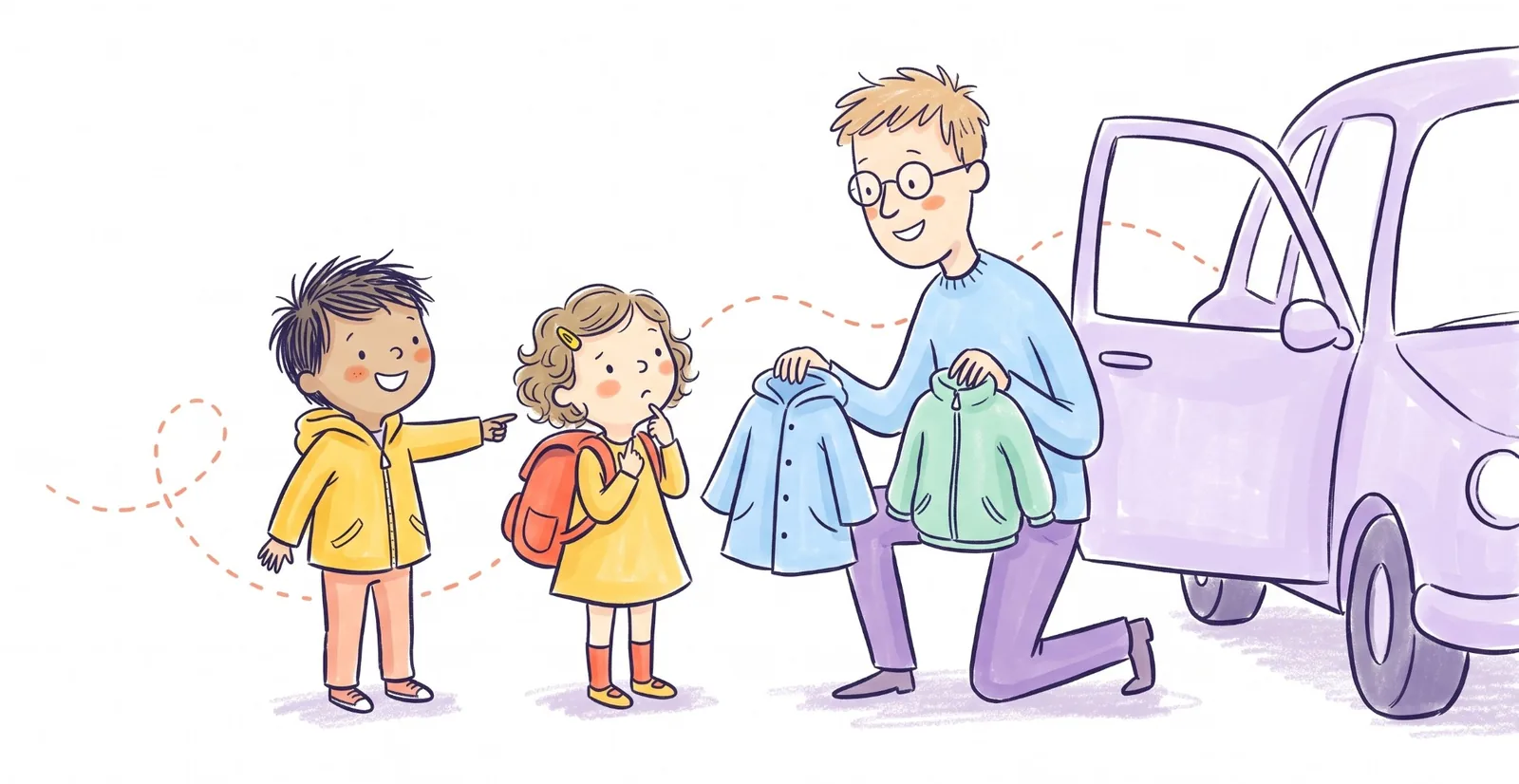
"Time to get in the car." "No."
"Do you want to climb in yourself, or should I lift you in?" "...I'll climb."
Same child, same car, same afternoon. The only thing that changed was the question. The first version is an order a child can refuse. The second is a decision they get to make, and both answers end with them in the car.
Offering two choices is one of the simplest tools a parent has, and one of the easiest to get slightly wrong. Here's why it works, how to do it well, and the moments it helps most.
Why two choices work
Small children control very little of their day. They're told when to wake up, what to wear, when to leave the park and when to go to bed. A lot of the pushback parents see is a child grabbing at the one thing they can control: whether to say no.
A choice gives them something better to control. A research brief for early-childhood educators from the Center on the Social and Emotional Foundations for Early Learning puts it simply: choice gives children a sense of control over their surroundings, and children tend to be more cooperative and engaged when they have some say (CSEFEL What Works Brief 15). The studies it draws on found choice linked to more engagement and less disruption and aggression, mostly with four- and five-year-olds.
One of the best known is a 1994 study of elementary students with emotional and behavioural challenges. When they were allowed to choose which of their assignments to work on, they were more engaged and less disruptive than when the same work was assigned to them (Dunlap et al., Journal of Applied Behavior Analysis).
It isn't the same as letting kids do whatever they want. Researchers who study "autonomy-supportive" parenting are careful to separate it from being permissive: you still set the limits and the structure, and the child gets a real say inside them (Joussemet, Landry & Koestner, Canadian Psychology, 2008). Two choices is that idea in its smallest form.
How to give a choice that works
1. Both options have to be fine with you
This is the rule that makes everything else work. If one of the options is something you'd hate, you're not offering a choice, you're hoping they pick the other one.
"Do you want to wear your raincoat or your fleece?" works if you're happy with either. "Do you want to wear your raincoat or get wet?" isn't a choice. It's a warning in disguise, and kids can tell.
2. Choose the how, not the whether
Whether you're leaving the park isn't up for discussion. How you leave can be:
- "Do you want to walk to the car or race me?"
- "Do you want to say goodbye to the swings or the slide?"
- "Do you want to carry your backpack or give it to me?"
The decision that matters is already made. The child gets to make one that matters to them.
3. Keep it to two
Three or four options can be harder than none for a tired five-year-old. The CSEFEL brief notes that fewer options are better for young children, and you can add more as they get older and used to it. Two is easy to hold in your head and easy to answer.
4. Ask, then wait
Give the choice once, then give them a moment to decide. If they don't choose, or choose something that wasn't on the list, calmly choose for them: "Looks like you want me to pick. I'll lift you in." Then do it, kindly and without a lecture.
That last step is what keeps the choice real. If not choosing gets them out of it, they'll learn not to choose.
5. Safety isn't a choice
Buckling into a car seat, holding hands in a parking lot and taking medicine aren't up for debate. But even here there's usually a small choice inside the rule: "Do you want to do the top buckle or should I?" "Do you want to hold my hand or hold onto the stroller?"
6. Don't use it for everything
Choices are a tool for the sticky moments, not a menu for every request. If a child has to pick between two options every time you ask them to do something, it becomes tiring for both of you. Save them for the times you know tend to turn into a standoff.
Where choices help most
Most of the standoffs in a family happen at the same few points in the day: the moments you have to stop doing one thing and start another.
| Moment | Instead of | Try |
|---|---|---|
| Getting dressed | "Get dressed, we're late." | "Blue shirt or the dinosaur one?" |
| Leaving for school | "Shoes on." | "Do you want to put your shoes on by the door or on the stairs?" |
| Pickup | "Come on, we're going." | "Do you want to tell me about your day now or in the car?" |
| Leaving the park | "Time to go." | "One more slide or one more swing, then we go?" |
| Homework | "Do your homework." | "Spelling first or math first?" |
| Bath and bed | "Bath time." | "Bath now, or one more page of your book first?" |
Food is the classic example. Nemours KidsHealth suggests parents decide what healthy foods are offered and let the child decide which of them to eat, and warns that bribes and threats at the table create a power struggle (KidsHealth). That's two choices at the dinner table: you choose the menu, they choose from it.
As kids get older, the choices can get bigger. A six-year-old picks between two shirts. A ten-year-old can pick when in the afternoon homework happens, as long as it's done before screens.
What if they pick neither?
Some children will test it, especially at first. "Neither!" is a very satisfying thing to say.
Stay calm and stay with the two options: "Those are the two choices. Do you want to pick, or shall I?" If they still won't, choose for them and follow through, without anger. It usually only takes a few times for a child to learn that choosing is better than having it chosen for them.
And if a request keeps turning into a fight whatever you try, it helps to look at how the first ask is made. We wrote about that in how to get kids to listen the first time, and about the moments it boils over in three things to tell yourself before you react.
Two choices work for grown-ups too
There's a reason a clear choice gets a faster answer than an open question. "Can anyone get the kids Thursday?" in the family group chat gets a thumbs-up, a "maybe", and silence. Nobody's quite sure whether they've said yes.
In Kid Pickup, every pickup asks one question with two answers:
- Grandma, the other parent or the sitter gets a notification with two buttons: I'll do it, or Can't make it. No maybes, and no wondering whether a thumbs-up meant yes.
- "I'll do it" puts their name on the pickup, so the whole family can see who's going.
- "Can't make it" tells you straight away, while there's still time to ask someone else.
- If nobody has taken it, the app sends a nudge to the parents the day before, three hours before and two hours before.
Two clear choices, one clear answer, for the kids and the grown-ups alike. Kid Pickup is on iPhone with a 14-day free trial, and grandparents and sitters never pay.
FAQ
Why does giving kids choices work?
Choices give children a sense of control over a day that's mostly decided for them, and research with young children links choice to more cooperation and engagement and less disruptive behaviour. When the decision that matters is already made, a small choice gives them something to say yes to.
How many choices should I give a toddler?
Two. Young children manage fewer options better, and two is easy to remember and answer. You can offer more as they get older.
What if my child won't choose?
Calmly offer the same two options once more, then choose for them and follow through without anger. If not choosing gets them out of it, the choice stops working.
Should both choices be things I'm happy with?
Yes. If one option is something you'd hate, it isn't a real choice. "Raincoat or fleece?" is a choice; "raincoat or get wet?" is a warning.
Is giving choices the same as being permissive?
No. You still decide the limits, like that you're leaving the park or that the car seat gets buckled. The child chooses something small inside those limits, like how you leave or who does the top buckle.