
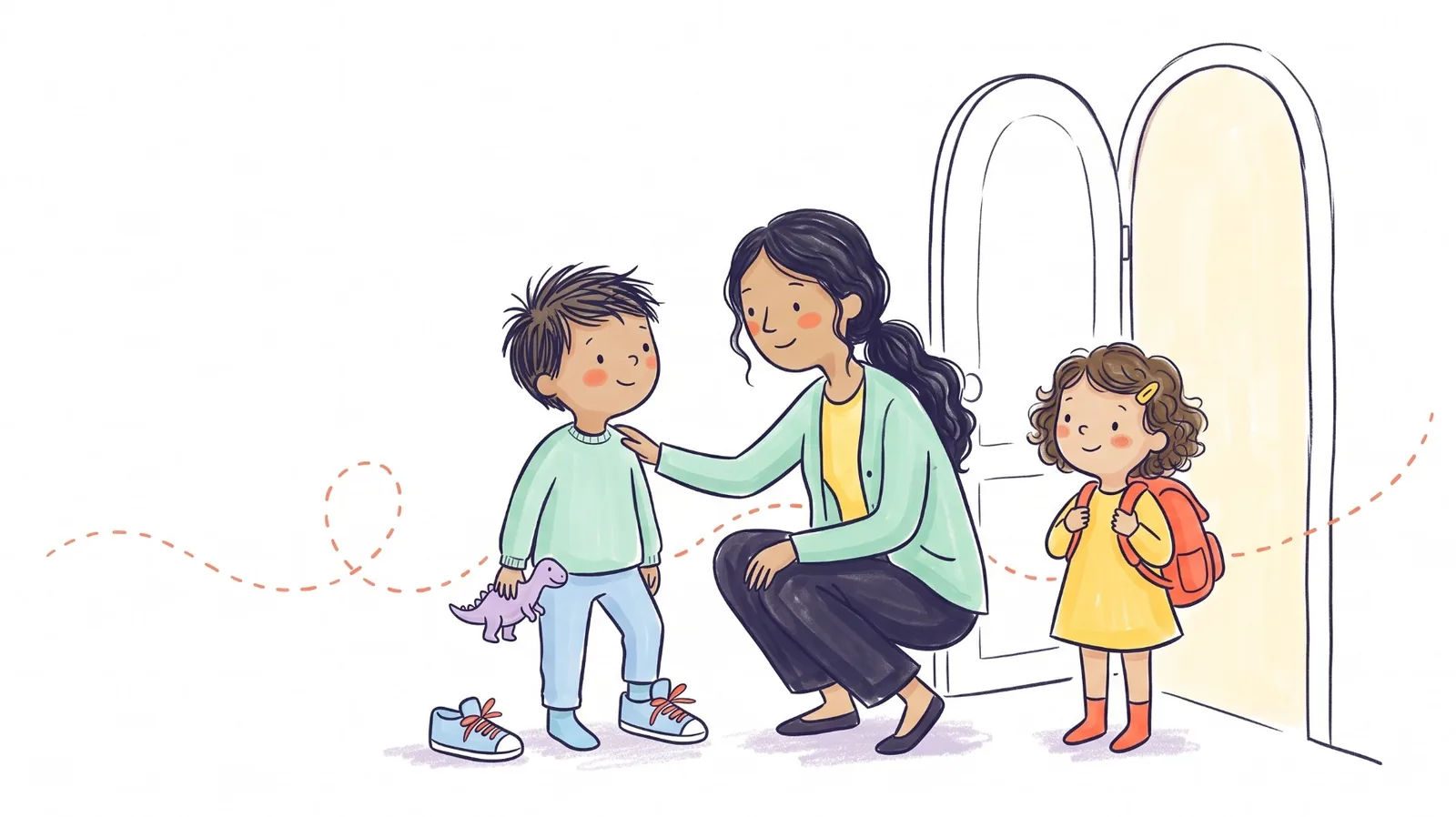
"Shoes on, please." Nothing. "Shoes on." Still nothing. "Can you put your shoes on? We're going to be late." A shoe moves an inch. "SHOES. ON. NOW." And suddenly, both shoes are on.
If that sounds like your house, here's the uncomfortable part: your child was listening the whole time. They were listening for the ask that actually meant it. Kids are very good at working out which request is the real one, and if the real one is usually the fourth, the first three are background noise.
The good news is that the same habit can be taught the other way round. Here's how to make the first ask the one that counts.
Why kids wait for the fourth ask
Children learn from what happens next, not from what we say. When a request is repeated, softened, turned into a question and then finally shouted, they learn that nothing happens until the shout. The CDC's parenting guidance says it directly: give one warning, because repeated warnings teach children they don't have to listen the first time (CDC, Steps for Giving Directions).
The way a request is worded matters too. "Can you put your shoes on?" sounds polite, but it's a question, and a question can be answered with no. The same CDC page recommends giving a direction as a statement, not a question, so it's clear the child is expected to do it.
None of this means a child who ignores you is being defiant. Often they're absorbed in what they're doing, didn't hear you, or didn't know you meant now. A clear first ask fixes all three.
How to make the first ask count
1. Get close first
Calling instructions from the kitchen to a child in the living room is the easiest way to be ignored. Walk over, get down to their level, say their name and wait until they look at you. The CDC suggests exactly this: get close, make eye contact and say their name before you give the direction.
It takes ten seconds and saves ten minutes.
2. Say it as a statement
"Shoes on, please." Not "Can you put your shoes on?" and not "Shoes, OK?"
A guide to Parent-Child Interaction Therapy from Virginia Tech's extension service makes the same distinction: a direct command says exactly what to do, while a question-style command leaves the child unsure whether they're actually expected to do it (Virginia Cooperative Extension, 2025). You can still be warm. "Please" is fine. It's the question mark that gives the job away.
Save questions for real choices: "Do you want the red jacket or the blue one?" is a question you're happy to have answered. More on that in give kids two choices.
3. One thing, and say what you want
"Get ready" is a lot of things. "Shoes on" is one. Young children in particular can only hold so much in their heads, so give one step at a time and add the next one when the first is done.
Say what you want to see, not what you don't. "Walking feet" tells a child what to do. "Stop running" only tells them what to stop.
4. Then wait, quietly
This is the hard part. After you ask, stop talking. Give them a few seconds to start. Parent-Child Interaction Therapy coaches parents to give a one-step direction and then wait five to ten seconds before doing anything else (Manhattan Psychology Group).
Repeating the request in that gap, even kindly, teaches them that the first ask was just the warm-up.
5. Warn once, then follow through
If they haven't started, give one calm warning that says what happens next: "Shoes on now, or I'll carry you to the car with them in my hand." Then, if nothing changes, do exactly that, calmly, without a lecture.
The follow-through is what makes the first ask believable next time. It doesn't need to be big. It needs to happen, and it needs to be something you're actually willing to do. A warning you won't carry out teaches the same lesson as asking five times.
6. Notice when it works
When they do it the first time, say so: "You put your shoes on as soon as I asked. Thank you." The CDC lists praise as the positive consequence of following a direction, and it's the part most of us forget when things go well.
Give them a heads-up before the change
A lot of "not listening" is really "not ready to stop". Leaving the park, turning off a show and getting out of the bath are all hard for children, because they have to stop something they like and start something they didn't choose.
A warning a few minutes before helps. Head Start's guidance for families of young children suggests giving toddlers a few minutes' notice before an activity changes, like "You have five more minutes to play so finish up what you are doing" (Head Start). Then, when the five minutes are up, your first ask is the only ask.
What gets in the way
- Counting to three as the real deadline. Counting works when it's the plan and you follow through at three, every time. If it's become the thing you say after the third ask, it's just another warm-up.
- The long explanation. Children deserve reasons, but a reason works better before you ask or once they've done it, not in the middle while their shoes are still off.
- Asking from across the room, or while you're looking at your phone. If it doesn't sound important, it isn't.
- Asking when you're already late. Rushed requests come out as shouts. The more of the afternoon that's planned, the calmer the asking gets. (For the moments it comes out as a shout anyway, here are three things to tell yourself before you react.)
Ask once works for grown-ups too
Think about how many times a week you ask the same question of the adults in your life. "Can you get the kids Thursday?" In the family group chat. Then again in a text. Then a call at 2:45 when nobody's answered.
Kid Pickup is built around asking once:
- Post the pickup once, and ask a person by name if you like. Grandma, the other parent or the sitter gets a notification with two buttons: I'll do it or Can't make it.
- Every pickup ends up with one name on it, so nobody has to ask "who's getting her?" again.
- If nobody has taken it, the app sends a nudge to the parents the day before, three hours before and two hours before, so you're not the one chasing.
- Whoever is doing it gets a reminder before they leave, at the time you choose.
One ask, one answer, and the shoes are the only thing left to argue about. Kid Pickup is on iPhone with a 14-day free trial, and grandparents and sitters never pay.
FAQ
How do I get my child to listen the first time?
Get close and get their attention, give one specific direction as a statement rather than a question, then wait quietly for a few seconds. If they don't start, give one calm warning and follow through. When they do listen the first time, notice it and say thank you.
Why does my child only listen when I yell?
Usually because yelling has become the signal that you mean it. If the first few requests are often repeated with nothing happening, children learn to wait for the loud one. Making the first ask clear and following through calmly teaches them the first ask is the real one.
Is counting to three a good idea?
It can be, if three really is the end and you follow through every time. It stops working when it becomes something you say after asking several times already, because then it's just another warning.
How long should I wait after asking my child to do something?
A few seconds, without repeating yourself. Parent-Child Interaction Therapy coaches parents to wait about five to ten seconds after a one-step direction before following up.
What if my child still doesn't listen?
Give one warning that says what will happen, then do it calmly. Keep consequences small and something you're willing to carry out. Consistency matters more than size.