
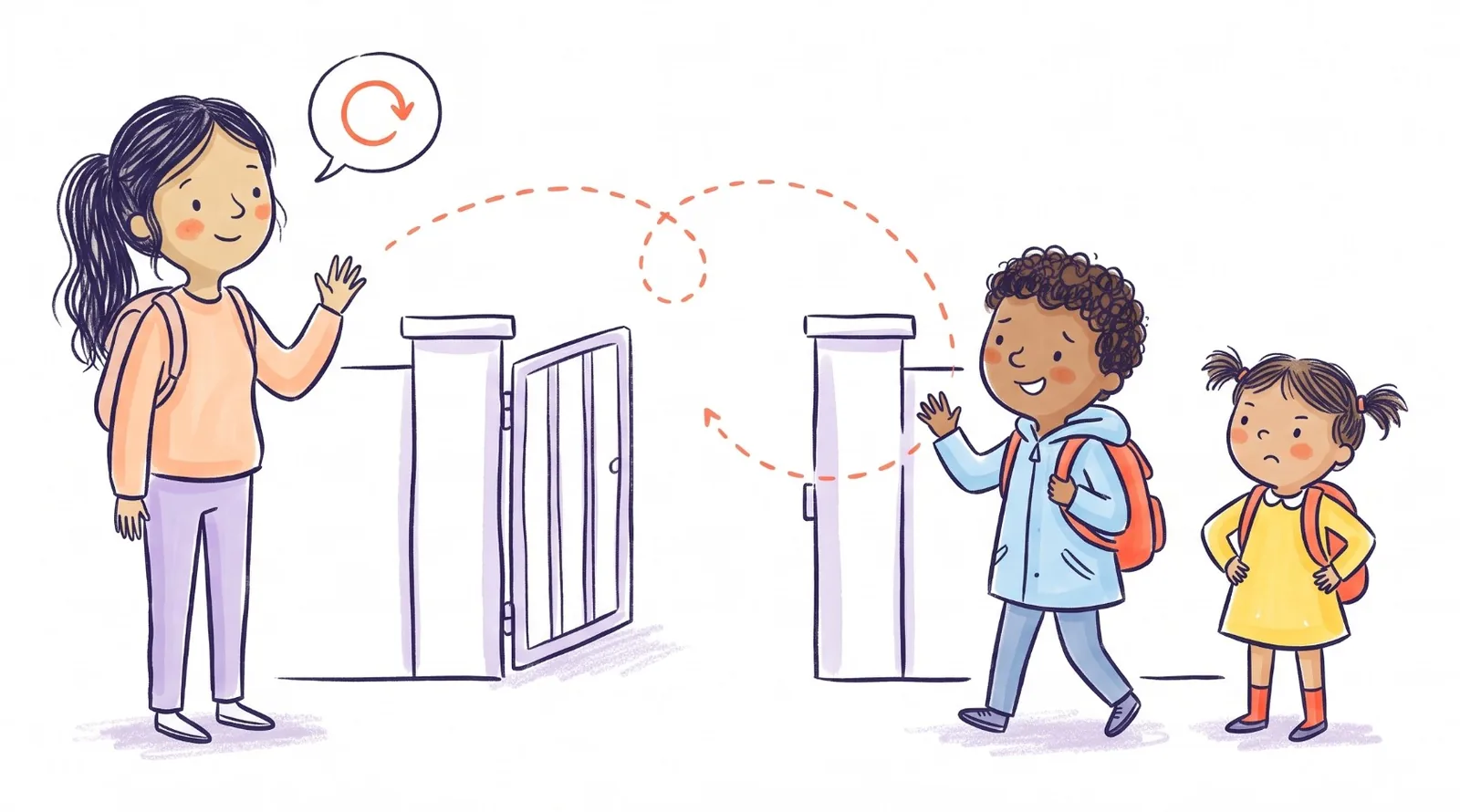
"Try again." Two words, said flat and friendly, and then you wait.
Your son grunts at Grandma instead of saying hi. Your daughter yells "I don't WANT to" at the car door. Somebody grabs the water bottle out of a sibling's hand in the back seat. The do-over is the same every time: name what you want instead if they're little, say "try again", and give them the chance to do it properly. When they do, you notice it out loud and move on. No lecture, no raised voice, no debate about tone.
It's not a new idea, and nobody owns it. Preschool teachers have been using it for decades. What makes it worth a post is how well it fits the ten minutes around pickup, which is where most families' manners fall apart, and how easy it is to hand to a grandparent or a sitter so your child hears the same thing from every grown-up.
Why a do-over beats a telling-off
Most corrections tell a child what they did wrong. A do-over makes them do the right thing, once, right now. That turns out to be most of what the advice from paediatricians comes down to.
The American Academy of Pediatrics says to teach right from wrong with calm words and actions, model the behaviour you want to see, and notice good behaviour and point it out, praising success and good tries (HealthyChildren.org). Its policy on discipline recommends positive reinforcement of appropriate behaviours, limit setting and redirecting, and tells parents not to threaten, insult, humiliate or shame (AAP). A do-over is all of the first list and none of the second, as long as you say it the way you'd say "pass the salt".
Zero to Three makes the point from the other side: punishment doesn't teach children what they should do instead (Zero to Three). "Try again" is the instead, said out loud and then done.
And there's a long run to it. A 2019 review of 154 trials of parenting programmes found that, of 26 techniques coded, only three were tied to stronger effects on children's disruptive behaviour: positive reinforcement, praise in particular, and natural or logical consequences (Leijten et al., JAACAP, 2019). The redo is the moment that earns the praise. Without it you're praising nothing in particular.
What it sounds like at pickup
The grunt at Grandma. Grandma says "Hi, love!" and gets a shoulder. You, or Grandma: "That's not how we say hello. Try again." Then wait. "Hi Grandma." "There he is." Done. Grandma doesn't need to be hurt, and you don't need to be embarrassed, because the whole thing took four seconds.
The yell at the car door. "I don't WANT to go to swimming!" Quiet voice: "You can tell me that in a normal voice. Try again." If what comes back is "I don't want to go to swimming" in a sulk, that's a pass. Sulky but civil is the bar for a six-year-old at 3:30. Now you can talk about swimming.
The grabbed water bottle. "Give it back, then ask her. Try again." The bottle goes back, "Can I have the water?", and you let the sister answer. If she says no, that's a different lesson, and it can wait till you're parked.
The slammed door at the sitter's. The door gets opened and closed again, properly. Lucía doesn't have to decide whether it was an accident.
Two things make these land. The first is that the ask is specific. The Child Mind Institute's advice on instructions is to be specific, make statements rather than questions, give the instruction once, then wait a few seconds without repeating it (Child Mind Institute). "Try again" on its own works for a nine-year-old who knows exactly what you mean. A four-year-old needs the model first: "We say 'Hi Grandma'. Try again." The CDC's guidance for toddlers and preschoolers says the same thing another way: tell your child what to do, not just what to stop doing, in a firm but calm voice, one direction at a time, and praise them when they follow it (CDC).
The second is that you wait. The few seconds after "try again" are the whole technique. Fill them with talking and the child never has to do anything.
When not to say it
Mid-meltdown. A child who is crying and shouting can't redo anything, and asking them to is fuel. The Child Mind Institute's guidance on tantrums is blunt about this: don't talk to a child when they're not available, and do the teaching when they're calm and you're calm (Child Mind Institute). At the gate that means getting them to the car first. The do-over can happen five minutes later, or at home: "Earlier, at the door, you shouted at me. Show me how you'd say it now."
With a two-year-old. Zero to Three's line is that toddlers are not yet able to stop their impulses, and children won't completely master self-control until school age (Zero to Three). A toddler can repeat "please" after you. They can't be expected to catch themselves and redo a grab. Model it, show them how, and keep the bar low. Harvard's guide to self-regulation activities is organised by age for the same reason: these are skills built through interactions and practice, and what counts as a pass at three is different from a pass at seven (Harvard Center on the Developing Child).
When you're already cross. Said through gritted teeth, "try again" is a put-down, and humiliating or shaming a child is exactly what the AAP's discipline policy tells parents not to do. If you can't say it flat, say nothing for a minute. Things to tell yourself before reacting is for that minute.
As the only tool. A do-over handles a moment that went wrong. It doesn't handle a child who's hungry, overtired or has been holding it together all day, which covers a lot of car lines. Snack first. Redirecting catches the seat-kick before it needs correcting at all, and a when-then gets the buckle done.
The honest caveat about praise
The research is good on the overall shape of this, and weaker on the moment-to-moment bit. A 2018 analysis of 19 experiments found that praise on its own had no measurable effect on whether children complied with an instruction right then, while time-out and ignoring did (Leijten et al., PLoS ONE, 2018). So "There he is" after a redone hello isn't a lever that makes the next hello happen. What the longer-term research supports is that families who notice and reinforce the right behaviour, consistently, see less of the wrong kind over months. A do-over is a way of making that habit concrete. It is not a trick that fixes Tuesday.
Hand the same two words to everyone who does pickup
The NHS's advice on behaviour says children need consistency, and that everyone close to your child should deal with their behaviour the same way (NHS). This is the one technique that's easy to pass on, because it's two words and no theory. Grandma doesn't need to read about positive reinforcement. She needs "if he's rude, say 'try again' and wait, and when he does it say thanks."
That's a message to everyone who does pickups, and in Kid Pickup it goes in the family chat once, where the sitter and both grandparents see it: "If she grunts or yells, 'try again', calm voice, then wait. Snack's in the front pocket." Each pickup on the calendar has one name on it, so you know who'll be at the gate on Thursday and can tell your child the night before, which saves a fair number of grunts in the first place. The app sends the family a notification when the pickup's done, so you hear it went fine without asking.
Kid Pickup is free for two weeks on iPhone for new subscribers, and grandparents and sitters don't pay.
FAQ
What should I say when my child is rude to me?
Stay calm, say what you want instead if they're young ("we say 'hi Grandma'"), then "try again", and wait. When they redo it, acknowledge it briefly and move on. Don't lecture, and don't try it in the middle of a meltdown; wait until they've calmed down, even if that's at home.
Does "try again" work for toddlers?
Partly. A two-year-old can repeat a polite word after you, but can't yet catch an impulse and redo a grab or a shove on request. Model the words, show them how, and keep expectations low. It becomes a real do-over around four or five, and the bar rises as they get older.
How do I correct my child's tone without yelling?
Give the instruction once, in a quiet voice, and then wait a few seconds without repeating it. "You can say that in a normal voice. Try again." A sulky but civil version counts as a pass. If you can't say it calmly, say nothing for a minute first.
Should I make my child redo something right after a tantrum?
Not during it, and not in the first minute after. Children who are crying or shouting can't take in an instruction. Get them somewhere calm, let the feeling pass, and do the redo later: "Show me how you'd ask for that now."
How do I get grandparents and babysitters to handle rudeness the same way I do?
Give them the exact words. "If he's rude, say 'try again' in a calm voice and wait, then thank him when he does it." Children do better when every grown-up responds the same way, and this is short enough to hand over in one message before the first pickup.