
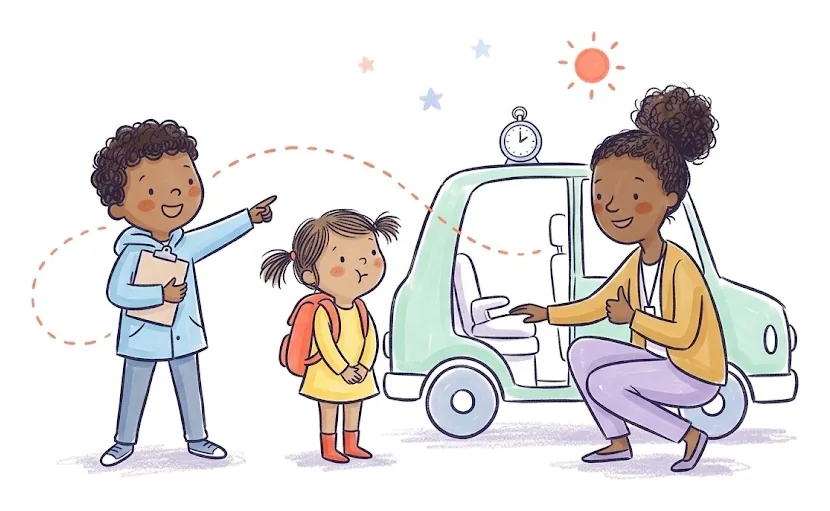
The best time to teach a five-year-old to wait in the car line is Saturday morning in the driveway, not Monday at 3:15 with twelve cars behind you. Kids learn a skill when nothing is at stake, and then use it when something is. Most of us do it the other way round: we explain the rule in the middle of the moment it's being broken, when nobody is listening.
This post is about the handful of pickup skills worth practising on purpose, how to practise them without it feeling like a lesson, and what to do when the real thing still goes sideways.
Why explaining in the moment doesn't stick
A child kicking the seat in the car line isn't short of information. They know you want them to stop. What they're short of is practice at the thing you want instead, under conditions calm enough to actually do it.
The CDC's advice for preschoolers puts it in two lines: explain and show the behaviour you expect from them, and whenever you say no, follow up with what they should do instead (CDC). The American Academy of Pediatrics adds the timing: prepare children for upcoming activities and how you want them to behave, and teach with calm words and actions (HealthyChildren.org). Both are saying the teaching happens before, not during.
There's a reason routines are easier for kids than one-off instructions. The CDC's page on structure says routines and rules help kids feel safe and know what to expect (CDC). A pickup your child has walked through a few times, in play, is a routine. One they've only been told about is a surprise every day.
Pretend play is practice
Harvard's Center on the Developing Child describes what happens when three- to five-year-olds play pretend: they make up rules to guide the role they're playing, hold those rules in mind, and hold back impulses that don't fit the part (Harvard Center on the Developing Child). That is the same muscle a child uses to sit still in a booster seat while the car in front takes forever.
The same sheet notes that children playing together often regulate each other's behaviour, which is a useful thing to know if you have two. The older one playing "the grown-up at the gate" will police the rules harder than you would.
There's one caution. A 2022 study that gave four- to six-year-olds twenty sessions of pretend play found they got better at self-control within the play sessions, but the gains didn't carry over to other settings (Adam et al., Journal of Experimental Child Psychology, 2022). It's one study, but it points the same way as common sense: practise the actual thing, in or near the actual place. A game of "pretend car line" in the living room is a start. The driveway is better. The real gate on a quiet day is best.
Four pickup skills worth rehearsing
Buckling up without a fight. Park in the driveway. Your child climbs in, buckles, you check it, they unbuckle, and you both go inside. Three times, two minutes, done. Make it a race against a song if they like that. The point is that "get in and buckle" becomes something their body knows how to do, so on Monday it isn't a negotiation.
Waiting at the gate. Stand at the front door and pretend it's the school gate. You're the teacher. They wait with their backpack on until you say their name and point to the grown-up. Swap roles: now they're the teacher and you're the kid who forgets to wait. They will love correcting you.
Going to a different grown-up. This is the one that causes tears. Grandma is doing Thursday for the first time, and your child has never gone to anyone but you. Rehearse it: a stuffed animal is Grandma, or better, Grandma herself comes for a practice pickup at the door. Walk through it: "I'm not here today, Grandma is. You go to Grandma, she buckles you in, you're home by four." Say it the same way each time.
Saying goodbye and going in. Drop-off is a skill too. Practise the handover at home: a hug, a set phrase ("See you at three, love you"), and the walk away. The set phrase matters more than it looks. Kids hold on to the script when the feeling gets big.
Keep each rehearsal short and stop while it's still fun. If your child wanders off after two rounds, you're done for today.
Make waiting a game
Waiting is the hardest of these, because there's nothing to do. The Harvard sheet lists freeze dance as a self-control game: when the music stops, children have to stop too (Harvard). It also mentions cooking, where kids practise holding back while they wait for the next instruction. Those translate to the car and the sideline:
- Statues. In the car line, "freeze" on your word and hold it until the car moves. Younger kids find this hilarious for longer than you'd expect.
- Count the colours. Five red things before we reach the gate. Then five blue.
- The quiet game, with a prize that isn't a screen. Whoever is quiet until the gate opens picks the song home.
- The job. Hand them something to hold or watch: the water bottle, the lunchbox, "tell me when you see Mrs. Patel."
None of these need a phone, which matters, because a tablet handed over in the car line teaches one thing: that waiting means screen.
Catch them doing it
Practice only works if the real thing gets noticed. The Child Mind Institute puts it simply: when children know exactly what they're being praised for, they're more likely to do it again (Child Mind Institute). "You buckled up before I even asked" does more than "good job". The AAP's tantrum guidance says the same: give specific praise in the successful moments (HealthyChildren.org).
The same page has the other half: set your child up for success, and if things fall apart when they're hungry, have a snack with you. No amount of rehearsal beats a child who hasn't eaten since 11:30.
When the real thing still goes wrong
It will, sometimes. A few things help:
- Don't teach in the moment. If the buckle fight happens anyway, get through it as calmly as you can and practise again at the weekend. A lecture at 3:15 teaches nothing anyone remembers.
- Shrink the ask. If waiting at the gate for five minutes is too much, make it two, and build up.
- Check what changed. A child who had this down and lost it is usually tired, hungry, sick, or dealing with something at school. Practise less, ask more.
- Use the tools for the moment. Redirecting catches the seat-kick early. A when-then ("when you're buckled, then the snack") handles the one task that has to happen. Two choices gives them a say.
Everyone who does pickup needs the script
The rehearsal only holds if the real pickups match it. If you've practised "Grandma buckles you in, then snack, then home" and the sitter does it in a different order with different words, your child is back to improvising.
Kid Pickup helps with that part. Everyone who does pickups is in one place, so the script goes to all of them in the family chat: "He goes to the grown-up we told him about that morning, buckles himself, then gets the snack from the front pocket. Say 'home by four' when you see him; it settles him." Each pickup has one name on it, so your child can be told the night before exactly who's coming, which is half the battle with a first Grandma Thursday. And when the pickup's done, the family gets a notification, so you know the rehearsal paid off.
Kid Pickup is free for two weeks on iPhone for new subscribers, and grandparents and sitters don't pay.
FAQ
How do you teach a child to wait?
Practise it when nothing is at stake, in short rounds, and make it a game: freeze when the music stops, count five red cars, hold the water bottle until you reach the gate. Praise the specific thing they did ("you waited until I said your name"), and keep early waits short, building up over time.
What is behaviour rehearsal for kids?
Walking a child through a situation before it happens, usually as play: pretending the front door is the school gate, or practising buckling in the driveway. Children make up and follow rules in pretend play, which is the same self-control they need in the real moment.
How do I prepare my child for the school car line?
Rehearse the three pieces: waiting with their backpack on until they're called, going to the right car or grown-up, and buckling in quickly. Do it at home or in the driveway a few times, swap roles so they get to be the teacher, and give them something to do while they wait in the real line.
Why does my child melt down at pickup?
Usually some mix of hunger, tiredness and a day spent holding it together at school. A snack in the car helps more than anything. If the meltdown is about the pickup itself, a change of grown-up or a long wait, that's the part you can rehearse ahead of time.
How do I help my child go with Grandma or a sitter at pickup?
Tell them the night before and again that morning who's coming, in the same words each time. Practise the handover at home, with the real person if you can. Make sure the school has that person on the pickup list, and ask them to use the same routine you use: the same greeting, the same snack, the same words.