
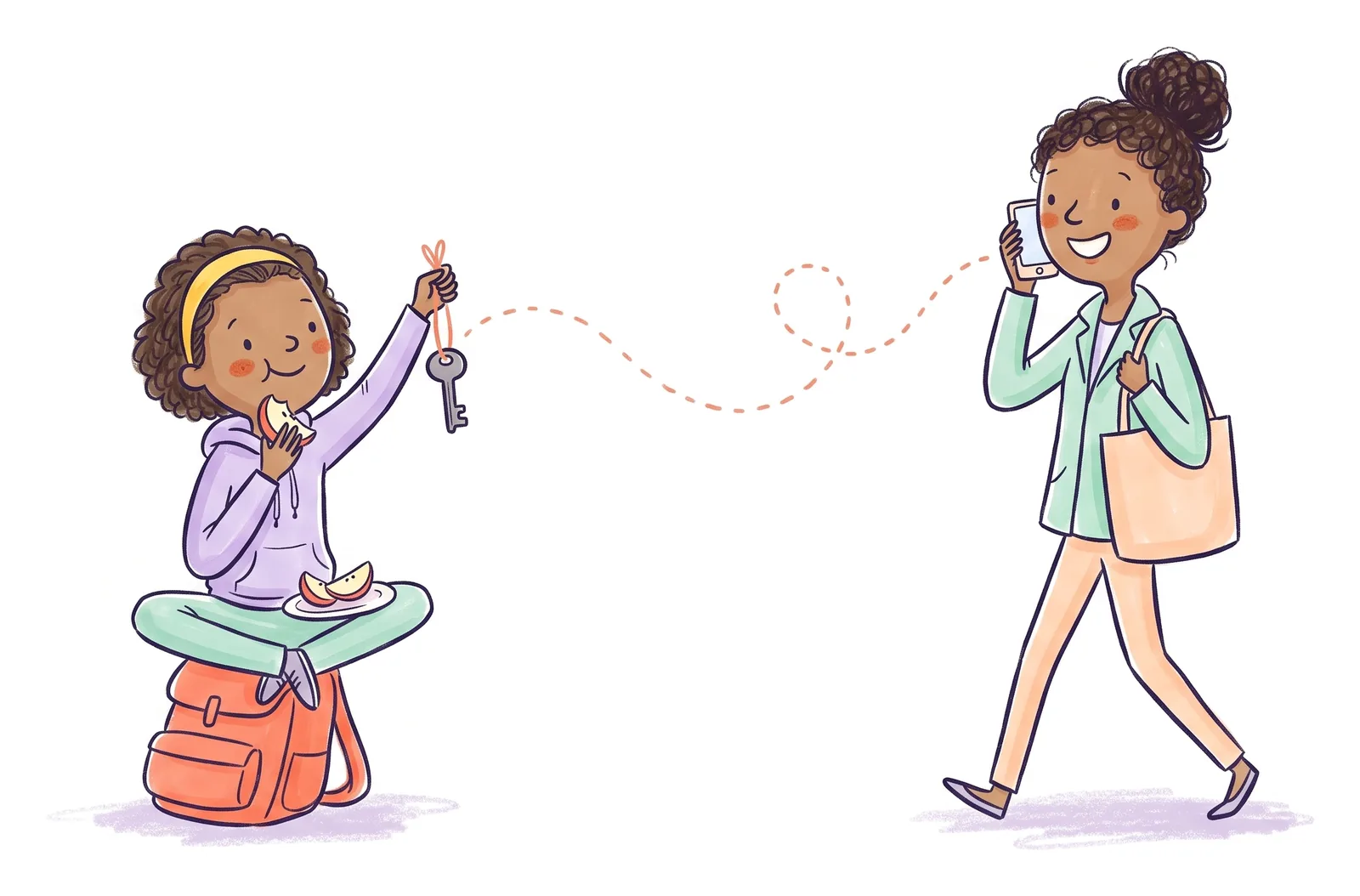
School ends at 3:00. You get home at 5:30. For a lot of families, that two and a half hours is the hardest part of the week to cover, and at some point the question comes up: could they just be home on their own?
Here's what the law says where you live, what safety groups recommend at each age, and how to tell whether your kid is ready.
Is there a legal age to leave a child home alone?
In most places, no. Most provinces, territories and US states don't set a minimum age. They expect the supervision you arrange to be reasonable for your child's age, maturity and situation.
In Canada, only three provinces set an age in law, according to a 2021 review by the Canadian Child Welfare Research Portal (CWRP Information Sheet 213E):
| Province or territory | Age in law |
|---|---|
| Manitoba | Under 12 can't be left unattended without provision for adequate supervision |
| New Brunswick | Under 12 can't be left unattended without provision for adequate supervision |
| Ontario | Statutory limit of 16 |
| British Columbia, Alberta, Saskatchewan, Nova Scotia, PEI, Newfoundland and Labrador, Yukon, NWT, Nunavut | No set age |
Quebec doesn't set an age for being home alone. Its only age rule is for leaving a child under 7 alone in a vehicle.
In Ontario, the Child, Youth and Family Services Act says no one in charge of a child under 16 may leave them "without making provision for his or her supervision and care that is reasonable in the circumstances" (Durham Children's Aid Society). That doesn't mean a 15-year-old can never be alone. It means the arrangement has to be reasonable.
In BC, there's no set age. When a concern is reported, social workers look at the child's maturity, the time of day, the safety measures in place and how long the child was alone (CBC News).
In the US, most states give guidelines rather than a legal age. The federal Child Welfare Information Gateway's factsheet on leaving children home alone lists Illinois (14), Maryland (8) and Oregon (10) as states with a set minimum age (2018 edition, copy here). State laws change, so check yours.
This is general information, not legal advice. Your local child protection office can tell you how they see it where you live.
What age do safety experts recommend?
Around 10 for short stretches, building up from there. The Canada Safety Council says parents "should not consider allowing a child to] stay at home alone before age 10," and then only if the child is mature enough and an adult is nearby to help ([Canada Safety Council).
It also suggests how long, by age:
| Age | How long, at most |
|---|---|
| Under 10 | Not alone |
| 10–12 | Up to two hours |
| 13–14 | Up to five hours |
| 15–16 | A whole day, with a parent reachable by phone |
The Canada Safety Council's ranges come from Durham Children's Aid Society in Ontario, which adds a detail that matters: at 10 to 12, phone-only contact is "generally unacceptable". A responsible adult should be nearby. At 13 to 14, an adult reachable by phone is enough for two to five hours (Durham CAS).
For the after-school gap, that's the useful part. A 10- or 11-year-old covering 3:15 to 5:00, with a neighbour or relative close by, fits the guidance. A 10-year-old alone from 3:00 to 7:00 doesn't.
Can a 10, 11 or 12 year old stay home alone after school?
Often, yes, for a short stretch, if they're ready and the setup is right. Here's a rough guide based on the ranges above:
- Under 10: Not alone. Have a sitter, after-school program, neighbour or older sibling cover it. In Manitoba and New Brunswick, anyone under 12 legally needs adequate supervision.
- 10–11: A short gap, up to about two hours, with a clear routine and a responsible adult nearby who knows they're home. Start with 20 or 30 minutes while you're close by.
- 12: Guidance still suggests up to about two hours, with an adult nearby who can check in.
- 13–14: Safety groups suggest up to five hours, with an adult reachable by phone.
Your child's maturity, your home and your neighbourhood count as much as the number.
Is my child ready? A quick checklist
These draw on questions from the Child Welfare Information Gateway and the Canada Safety Council.
- They want to. A child who's nervous about it isn't ready, whatever their age.
- They follow rules when you're not there. Think about the last time they were told not to do something.
- They stay calm when something unexpected happens, like a spill, a scary noise or a forgotten key.
- They know your full name, address and phone number by heart, and how to call 911 and when to.
- They know basic first aid for cuts, burns and nosebleeds.
- They can reach you or another adult every time, and know who to call if you don't answer.
- You feel okay about it. If you'd spend the whole time checking your phone, it's too soon.
The Canadian Red Cross runs a Stay Safe! course for kids 9 to 13, about five to six hours in person, covering safety at home, unexpected situations and basic first aid (Canadian Red Cross). It's a good way to start the conversation, and kids tend to take it more seriously coming from someone who isn't their parent.
How to set up the after-school routine
Ready isn't only about your child. It's also about the plan around them.
- Do trial runs first. Leave them for 20 minutes while you're at a neighbour's or the store. Then 45. Then a full afternoon you're close by for.
- Agree the house rules. Doors stay locked. Nobody comes in, friends included, unless you've said so. Nothing on the stove. What to do if someone knocks.
- Make the check-in automatic. They call or text the moment they're in, every time. If you haven't heard by 3:30, you know to act.
- Put the numbers on the fridge. You, a second parent or grandparent, a neighbour who's home in the afternoon, and 911.
- Sort out the key. A key on a lanyard, a lockbox or a keypad lock. Have a plan for the day it goes missing.
- Name a nearby adult. A neighbour who's home most afternoons and knows they're the backup.
Home alone is still part of the pickup plan
Even once they're old enough, some days won't fit the routine. A sore throat. An early dismissal. A Pro-D day. Basketball across town at 4:30. A dark, wet November afternoon when you'd rather someone was there.
Those are the days that slip, because everyone's got used to the routine and nobody thinks about cover until 2:45.
That's where Kid Pickup fits. The normal home-alone days stay off the plan. On the days that need someone, you post the pickup or drop-off, someone in your circle claims it, and the family gets a notification when they do. If nobody has it as the time gets close, the app sends parents a heads-up with time to sort it out. Grandparents, sitters and the neighbour who's home in the afternoon can join with their own role. A sitter sees only the open pickups, their own and ones they're asked about; grandparents see the week.
It doesn't track anyone's location, so a check-in call or text is still the way to know they're home (why we skip location).
If your child is walking home before they're home alone, this guide on walking home from school covers that part.
Frequently asked questions
Can a 10 year old stay home alone after school?
In most places it's legal, and the Canada Safety Council's guidance allows up to two hours from age 10 if the child is mature and a responsible adult is nearby to help. In Manitoba and New Brunswick, children under 12 legally need adequate supervision. Start with short trial runs. This isn't legal advice; check with your local child protection office.
What age can a child stay home alone in BC?
BC doesn't set an age in law. Social workers look at the child's maturity, the time of day, the safety measures in place and how long they're alone. The Canada Safety Council suggests not before 10.
What age can a child stay home alone in Ontario?
Ontario law requires supervision that's reasonable in the circumstances for children under 16. It doesn't name a minimum age for being home alone, but the arrangement has to be reasonable. Durham Children's Aid says children under 10 shouldn't be left unsupervised, and suggests one to two hours at 10 to 12 with an adult nearby. This isn't legal advice; check with your local child protection office.
How long can an 11 year old be left home alone?
The Canada Safety Council suggests up to two hours at a time for children 10 to 12, with a responsible adult nearby, and up to five hours at 13 to 14.
Can my 12 year old look after a younger sibling?
It depends on both kids and on where you live. In Manitoba and New Brunswick, a child under 12 needs adequate supervision, so the question is whether a 12-year-old gives the younger child that. Durham CAS notes that a child who can look after themselves may not be able to care for other children, so build up to it the same way.
Is it illegal to leave my child home alone?
In most of Canada and the US, there's no specific age in law; the test is whether the supervision is reasonable for your child and situation. A few provinces and states do set ages. This isn't legal advice, so check the rules where you live.