The first time you leave your child home alone, you'll say six things at the door on your way out. Don't answer it. Don't touch the stove. Call me if anything happens. They'll nod at all of them, and by the time you're at the corner they'll remember two.
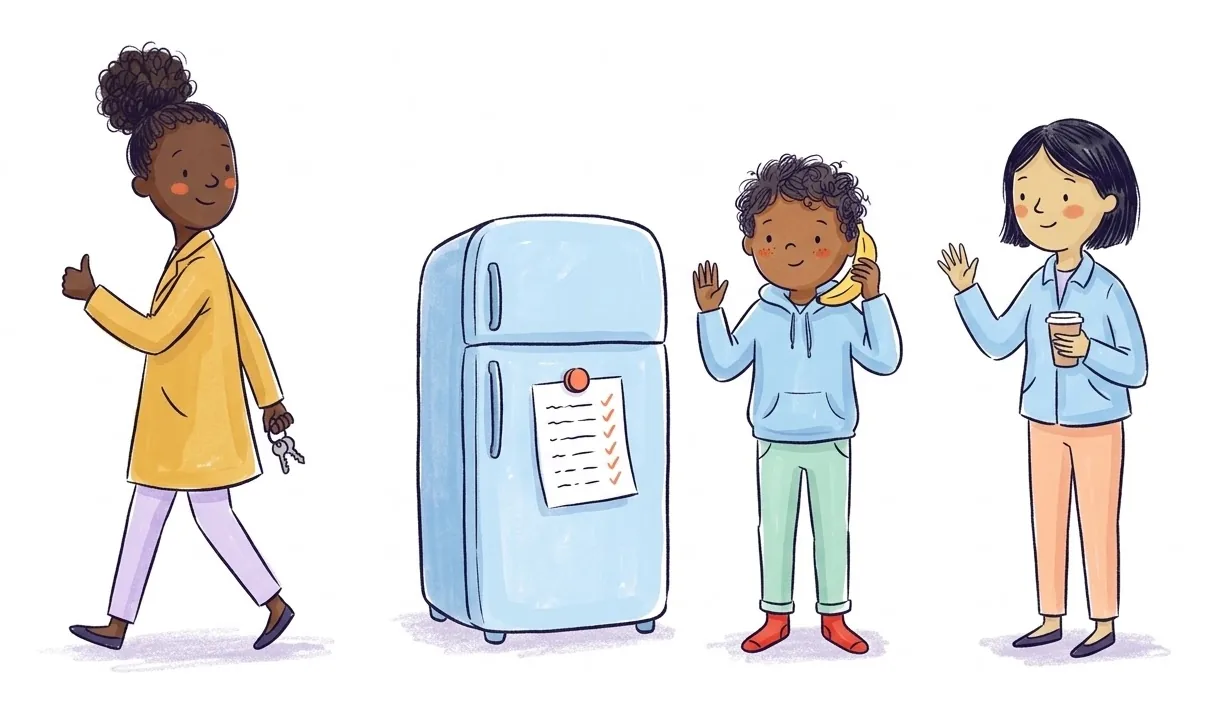
Rules said at the door don't stick. Rules you've written down together, practised once and put on the fridge do. Here's a set to start from, where each one comes from, and how to run the first try.
Whether your child is old enough is a separate question, and we've answered it in how old a child can stay home alone. This post is for when you've decided they are.
The rules, short enough for the fridge
Change the wording to fit your house. Shorter is better.
When I'm home on my own
1. I text or call when I get in. Every time.
2. The door stays locked. I don't open it for anyone unless we've agreed it beforehand.
3. I don't tell anyone on the phone or online that I'm alone.
4. No stove and no oven. Snacks are in the cupboard.
5. No friends over, and I don't go out, unless we've agreed it.
6. If the smoke alarm goes off or I smell smoke or gas, I get out first and call from outside.
7. In an emergency I call 911 first, then you.
8. If I'm scared, bored or not sure, I call. That's never getting in trouble.
The free home-alone readiness checklist has a house rules sheet you fill in on screen, with your address, your numbers and the neighbour to go to, and it prints on one page.
Rule 1: Check in the moment you're home
The American Academy of Pediatrics puts it simply: "Your child should contact you to check in when they first get home." It doesn't need to be a conversation. A quick call or text "creates a routine and gives you a chance to gauge how the day is going" (AAP, HealthyChildren.org).
Set your side of it too. If school lets out at 3:00 and the walk takes fifteen minutes, decide what you do when it's 3:30 and there's no text. That's the whole point of the rule.
Rule 2: The door
The Red Cross is firm on this: "Never open the door to strangers," and that includes people in uniform. "Never open the door to delivery people or service representatives. Ask delivery people to leave the package at the door or tell them to come back at another time" (American Red Cross).
Most families land on the simplest version, which is that the door doesn't get answered at all. If there are exceptions, name them. "Grandma, and Mrs. Okafor from next door" is a rule a ten-year-old can follow. "People we know" isn't, because the man who reads the meter is someone they've seen before.
Rule 3: The phone, and the internet
Old advice, still right. The Red Cross: "Never tell someone on the telephone that the parents are not at home." It suggests a line to use instead, along the lines of saying the parent is busy and offering to take a message. The AAP's version is "Mom's not available, can I take a message?" (AAP).
The newer half of the rule is online. The AAP's readiness questions include "not posting on social media that they are alone." A group chat with eleven classmates counts.
Rule 4: The kitchen
This is the rule with numbers behind it. The National Fire Protection Association reports that cooking is a leading cause of home fires, and that unattended equipment "is a factor in one quarter (25%) of reported home cooking fires and half of the associated deaths" (NFPA).
NFPA's own guide for kids draws the line later than most parents expect. Children aged 9 to 12 can use the microwave and turn burners on and off "when a grown-up is present." Operating "the stove or oven without an adult present" is on the list for kids aged 14 and up (NFPA, Kids in the Kitchen).
So for most children starting out, the rule is no stove and no oven. Decide about the microwave and the toaster, and whatever you allow, do it together first. The AAP: "Make sure your child has practiced with you before using any appliances." Then make the rule easy to keep. Leave food that needs nothing but a plate.
Rule 5: Friends over, and going out
The Red Cross says no to both without permission. The AAP adds the part parents forget. If friends are allowed over, "ensure the other parents are aware that no adult is home." You'd want to know.
Screens belong here too. You don't need a long policy. Decide what's fine, and what homework has to be done before it.
Rule 6: Smoke, gas and the lights going out
Getting out comes before calling anyone. The Red Cross: if a child smells smoke or hears a smoke alarm, "they should get outside and ask a neighbor to call the fire department." KidsHealth says the same about 911: if there's a fire, "they should know to leave the house before calling 911" (Nemours KidsHealth).
That only works if they know what the alarm sounds like and which way is out. Press the test button once while they're standing there. Walk both ways out of the house. Show them where the flashlight lives, because a power cut at 4:45 in December is dark.
If you have gas, teach the smell and the rule that goes with it: leave, then call. Weber State University's checklist for parents includes showing children "what gas smells like when it is leaking (if applicable) and what to do" (Weber State).
Rule 7: 911 first, then you
Children's instinct in a crisis is to call a parent. For a real emergency that's the wrong order. The AAP: "In a life-threatening situation, remind your child to call 911 before taking time to contact you."
Put the other numbers where they can see them. The Red Cross suggests an emergency list with "9-1-1, the parents' work and cell numbers, numbers for neighbors, and the numbers for anyone else who is nearby and trusted." The AAP suggests posting "the names and numbers of three neighbors and family members who live nearby", on paper, because a frightened child can blank on a number they've known for years.
Add poison control. In the US it's 1-800-222-1222 (Poison Control). In Canada it's 1-844-POISON-X, which is 1-844-764-7669 (Parachute).
Rule 8: Calling is never getting in trouble
This is the one that makes the others work. A child who thinks they'll be told off for breaking a glass will try to deal with the glass. KidsHealth suggests going further and making "a list of friends your child can call" or things to do if they get lonely (Nemours KidsHealth). The AAP suggests a video call or "texting a few silly photos" when either of you is anxious.
Your half of the list
Some rules are for the adults.
- Lock up what shouldn't be found. The AAP says all guns in the home "should be locked and unloaded, with ammunition locked separately," and estimates that 4.6 million children in the US live with guns that are loaded and unlocked (AAP). Alcohol and medicines go in the same category.
- If they take medicine, KidsHealth's advice is to "leave a precise dose" out and put the bottle away.
- Tell a neighbour. Fairfax County's guidance for parents: "Let a trusted neighbor know that your child may be home alone" (Fairfax County).
- Sort out the key, and what happens the day it's lost.
- Stay reachable. If you'll be in a meeting with your phone off, give them someone else to call.
Practise before the first time
Talking through the rules isn't enough. Do a short rehearsal.
Play "what would you do if" over dinner. The University of Wisconsin's extension service built a whole handout around it (UW-Extension). Some to try:
- Someone knocks and says they have a package that needs signing for.
- The toast gets stuck and starts to smoke.
- You get home and the front door is already open.
- The power goes out.
- Your friend texts that he's coming over.
- You cut your finger and it won't stop bleeding.
You'll learn more from the answers than from any checklist. Then run a trial. KidsHealth suggests letting a child stay alone "for 30 minutes to an hour while you remain nearby and easily reachable." Go to a neighbour's or the corner shop. Afterwards, ask how it went, and ask what the boring part was as well as the scary part.
How long is long enough?
Start short and build. Two published guides, for a sense of scale:
| Age | Fairfax County, Virginia | Canada Safety Council |
|---|---|---|
| 8 and under | Always with a responsible person | Not alone |
| 9 to 10 | Up to 1.5 hours, in daylight and early evening | Not before 10 |
| 11 to 12 | Up to 3 hours, in daylight and early evening | Up to two hours for ages 10 to 12 |
| 13 to 14 | More than three hours, not overnight (ages 13 to 15) | Up to five hours |
Sources: Fairfax County child supervision guidelines; Canada Safety Council. These are guidelines, not law, and they're for a child who's ready. The law where you live is in our home-alone age lookup. For whole days, see can a child stay home alone all day.
If a younger brother or sister is home too
That's a different job, and the rules above don't cover it. Looking after yourself means following instructions. Looking after a six-year-old means making decisions. The Red Cross babysitting courses start at 11 in both countries (American Red Cross), and the Canadian Red Cross runs a Stay Safe! course for "youth ages 9 to 13" that covers being home alone (Canadian Red Cross). Either is worth an afternoon.
For the days it doesn't work
You're in good company. By the Afterschool Alliance's last full count, 7.7 million American children were on their own after school in 2020 (America After 3PM). But home alone suits some days and not others. A sick day, an early dismissal, a practice across town, or a week when your child just isn't feeling brave all need a person.
That's what Kid Pickup is for. Each of those days goes on a shared calendar, and a grandparent, neighbour or sitter taps "I'll do it". If a day still has nobody, the app sends a nudge while there's time to ask.
FAQ
What are good rules for kids staying home alone?
Check in on arrival, keep the door locked and don't open it, don't tell anyone you're alone, no stove or oven, no friends over or going out without permission, get out first if there's smoke or gas, call 911 first in an emergency, and call a parent any time you're unsure.
Should a child answer the door when home alone?
The Red Cross says never to open the door to strangers, delivery drivers or service workers. Most families keep it simpler: the door stays shut unless a visit was agreed beforehand with a named person.
Can my child use the stove when home alone?
The National Fire Protection Association's guide for kids puts using the stove or oven without an adult at age 14 and up. For younger children, leave food that needs no cooking, and practise with any appliance you do allow.
What should my child do if there's a fire when they're home alone?
Get out of the house first, then call 911 from outside or from a neighbour's. Practise both ways out and let them hear the smoke alarm so they know the sound.
How long can a 10-year-old stay home alone?
Guidelines vary. Fairfax County, Virginia suggests up to an hour and a half for ages 9 to 10, in daylight. The Canada Safety Council suggests up to two hours for ages 10 to 12. Start with half an hour and build up.
What number should kids call for poisoning?
In the US, Poison Control is 1-800-222-1222. In Canada, call 1-844-POISON-X (1-844-764-7669). If someone has collapsed or can't breathe, call 911.
How do I prepare my child to stay home alone for the first time?
Write the rules together, post emergency numbers, walk through the fire exits, and ask "what would you do if" questions. Then do a 30 to 60 minute trial while you're close by, and talk about how it went.