
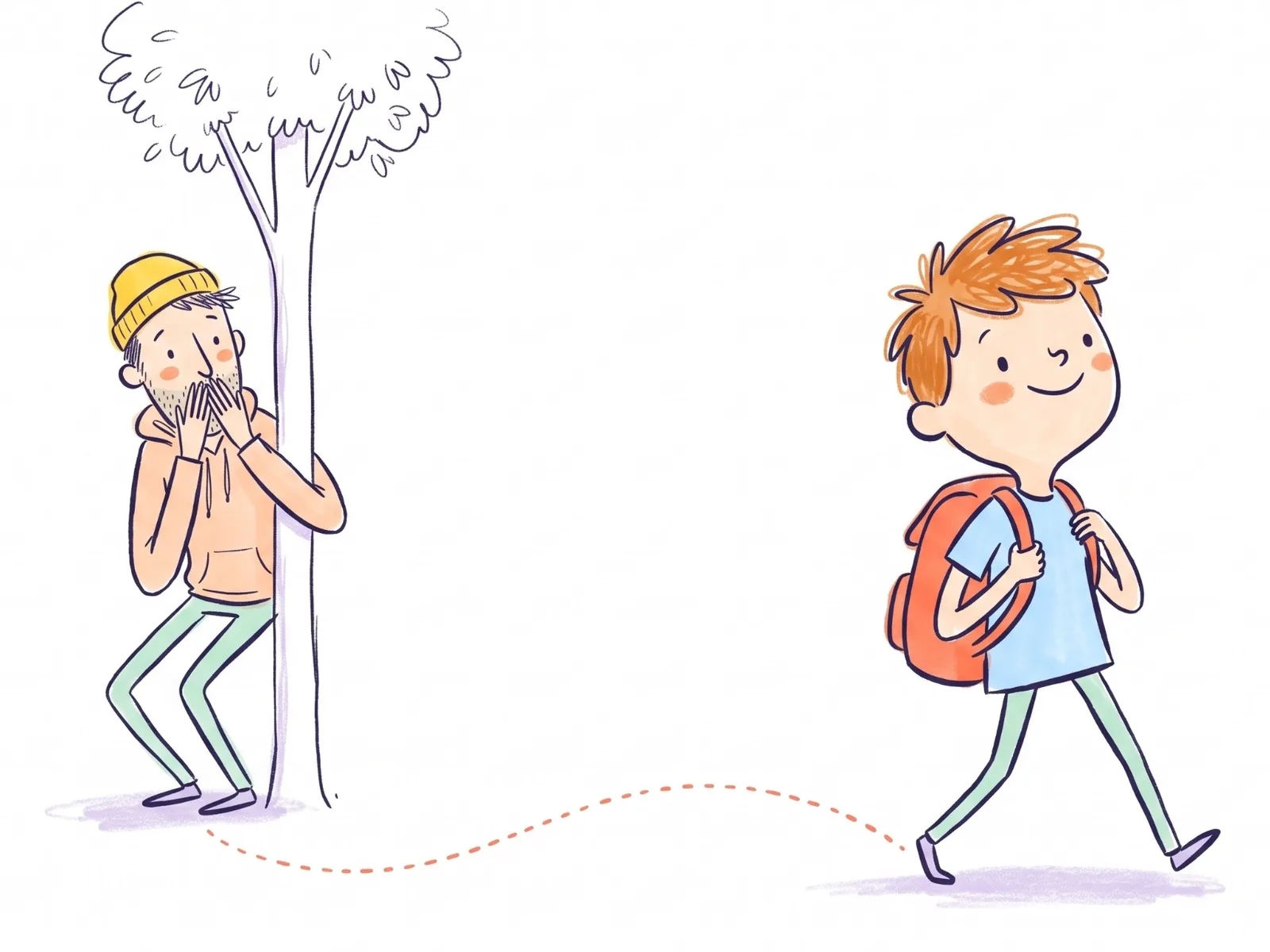
Somewhere around Grade 3 or 4, the question starts. Their friend walks home. The school is six blocks away. They're asking, and part of you wants to say yes.
Here's what the law actually says, what safety experts recommend, what other parents are doing, and a simple way to find out whether your kid is ready.
Is there a legal age to walk home from school alone?
In most places, no. Neither Canada nor most US states set a specific age for walking to or from school alone, though some name ages for leaving kids unsupervised. What the law does say is that kids need supervision that's reasonable for their age and situation.
In British Columbia, the Ministry of Children and Family Development told CBC there's no specific age law in B.C. or Canada for when a child can be left unsupervised. When a concern is reported, social workers look at things like the child's maturity, the time of day, the safety measures in place and how long the child was alone. A 2015 B.C. Supreme Court ruling about children under 10 has become a loose guide, not a rule (CBC News, 2017).
In Ontario, the Child, Youth and Family Services Act says no one in charge of a child under 16 may leave them "without making provision for his or her supervision and care that is reasonable in the circumstances." It doesn't name an age for walking to school (Durham Children's Aid Society).
In the US, there's no federal rule, and state neglect laws mostly don't name an age either. A growing number of states have gone the other way and protect kids' independence outright. As of April 2026, Let Grow counts 13 states with "reasonable childhood independence" laws, including Utah, Texas, Colorado, Virginia and Florida (Let Grow). Utah's, passed in 2018, says that letting a child who is mature enough travel "to and from school by walking, running, or bicycling" isn't neglect (Let Grow, Utah).
So the honest answer is that it's your call, as long as it's a reasonable one. This is general information, not legal advice. If you're unsure about where you live, your school or local child protection office can tell you how they see it.
What age do experts recommend?
Around 10. That's where the main safety groups land, and for the same reason: traffic.
- The American Academy of Pediatrics: "Children usually aren't ready to start walking to school without an adult until about fifth grade, or around age 10." Ideally, they walk with at least one neighbour child or an older sibling (HealthyChildren.org).
- Safe Kids Worldwide: "Children under 10 years old should cross the street with an adult," because "it can be hard for kids to judge speed and distance of cars until age 10" (Safe Kids).
- The Ottawa Safety Council: "a good guideline for starting to think about letting your child walk alone is age 10," and its WalkAlone program for kids ends with a readiness checklist (Ottawa Safety Council).
Notice the wording: "starting to think about," "usually." Ten is roughly when kids get better at judging traffic. It isn't a switch that flips on their birthday.
What age do other parents think is right?
Older than the experts, it turns out. In an on-site reader poll of 4,431 Canadian parents run by CanadianParent.ca in summer 2026, 59% said kids should be at least 11 before walking to school alone (CanadianParent.ca):
| Age parents chose | Share |
|---|---|
| Under 5 | 2.8% |
| 5–7 | 11.1% |
| 8–10 | 24.1% |
| 11–13 | 25.0% |
| Over 13 | 34.1% |
It was a poll of the site's readers, so it's a read on how parents feel, not a scientific survey. (The shares add up to 97.1%, and the poll page doesn't say where the rest went.) Still, if you're holding off until 11 or 12, you've got plenty of company.
Can a 6, 7, 8 or 9 year old walk home alone?
Here's a rough guide by age, based on the AAP and Safe Kids advice above. Your child, your route and your school's rules come first.
| Age | What usually makes sense |
|---|---|
| 6–7 | Walk with an adult or a responsible older sibling. Use the walk to teach the route and how to cross. |
| 8–9 | Practice runs. They lead, you follow. Maybe a short, simple route with a friend, if there are no busy roads or there's a crossing guard. Still cross streets with an adult. |
| 10–11 | Many kids are ready to walk alone on a familiar route once they pass the checklist below. |
| 12+ | Most kids can walk alone, including longer routes, as long as they know what to do when plans change. |
The route matters as much as the age. Six quiet blocks with a crossing guard is a different walk from four blocks along a busy road with no lights.
Is my child ready? A quick checklist
If you can tick all of these, your child is probably ready to try. It draws on the skills the Ottawa Safety Council and the AAP cover.
- They know the route and could walk it without you pointing the way.
- They know their address and your phone number by heart.
- They cross safely without reminders: at corners or crosswalks, looking all ways, and making eye contact with drivers.
- They stay focused. No headphones, no screen, no wandering off with friends.
- They know what to do if an adult approaches them or offers a ride: say no, keep walking, go to a safe place like the school or a store.
- They know what to do if something goes wrong: the door's locked, a road's closed, a friend wants them to go somewhere else.
- They check in when they get home, every time, the same way.
- They want to. A nervous kid who's pushed into it is more likely to freeze when something unexpected happens.
How to start: a two-week plan
Don't go from walking together to walking alone in one day. Build it up.
- Week 1, days 1–3: walk it together. Talk through the crossings, the landmarks and the safe spots along the way.
- Days 4–5: they lead. You walk beside them and stay quiet unless they make a mistake.
- Week 2, days 1–3: you follow behind. Stay half a block back. See how they handle it when they think you're not watching.
- Days 4–5: with a friend, or alone with a check-in. They walk on their own and tell you the moment they're home.
Then keep the check-in going for good. It's how you'll know the day something goes sideways.
One timing note: in most of Canada and the US, clocks go back on Sunday, November 1. If your child starts walking in October, the walk home gets darker within weeks. Bright or reflective clothing helps them be seen. In B.C., clocks don't change this year: the province moved to permanent daylight time in March, so afternoons keep the extra hour of light (B.C. government).
Tell the school
Some elementary schools won't let younger students leave as walkers without a parent's written permission, and some have their own age rules. Ask the office what they need. If a note works, this covers the basics:
Hi [office or teacher's name],
Starting [date], [child's full name] in [class or grade] has my permission to walk home from school on their own after dismissal. If plans change on a given day, I'll let you know in writing.
Thank you,
[Your full name], [parent/guardian], [phone number]
If someone other than you will sometimes pick them up instead, here's how school pickup lists work.
The days they can't walk
Walking home doesn't end pickups. It changes them.
There will be days when walking isn't the plan: pouring rain, a dark November afternoon, a sore throat, soccer practice across town, a playdate at a friend's house. Those are the days that slip, because everyone's used to the kid walking home and nobody thinks about pickup until 3:15.
That's where Kid Pickup fits. Walking days stay off the plan. On the days that need a ride, you post the pickup, someone in your circle claims it, and the family gets a notification when they do. If nobody has it as the time gets close, parents hear about it with time to sort it out. Grandparents, sitters and neighbours can help with their own role. A sitter sees only the open pickups, their own and ones they're asked about; grandparents see the week.
Kid Pickup doesn't track anyone's location. If you want to know the moment your child gets home, a check-in text or call is simpler and works with any phone (more on why we skip location).
Frequently asked questions
Can a 9 year old walk home from school alone?
Some can, on a short, familiar route with no busy crossings, especially with a friend. Safe Kids Worldwide says kids under 10 should cross the street with an adult, so it depends a lot on the route. Practise together first.
Is it illegal to let my child walk to school alone?
Generally, no law in Canada or most US states bans it; the question is whether it's reasonable for your child and your route. Some US states protect it explicitly. This isn't legal advice, so check local rules and your school's dismissal policy.
What age can a child walk home from school alone in Ontario?
Ontario law doesn't name an age. It requires reasonable supervision for children under 16, which depends on the child and the situation. Ontario safety groups such as the Ottawa Safety Council use around 10 as a starting point.
What is the legal age to walk to school alone in BC?
There isn't one. BC's Ministry of Children and Family Development has said there's no specific age in B.C. or Canada for when a child can be unsupervised. A 2015 B.C. Supreme Court ruling about children under 10 has become a loose guide, not a rule.
Should my child walk home with a friend instead of alone?
It's a good step between walking with you and walking solo. The AAP suggests walking with a neighbour child or older sibling where possible. Make sure both families know the plan.
Does my child need a phone to walk home alone?
Not necessarily. What matters is that they check in the same way every time, whether that's a call from the home phone, a text from a watch or a message from a tablet when they get in.