
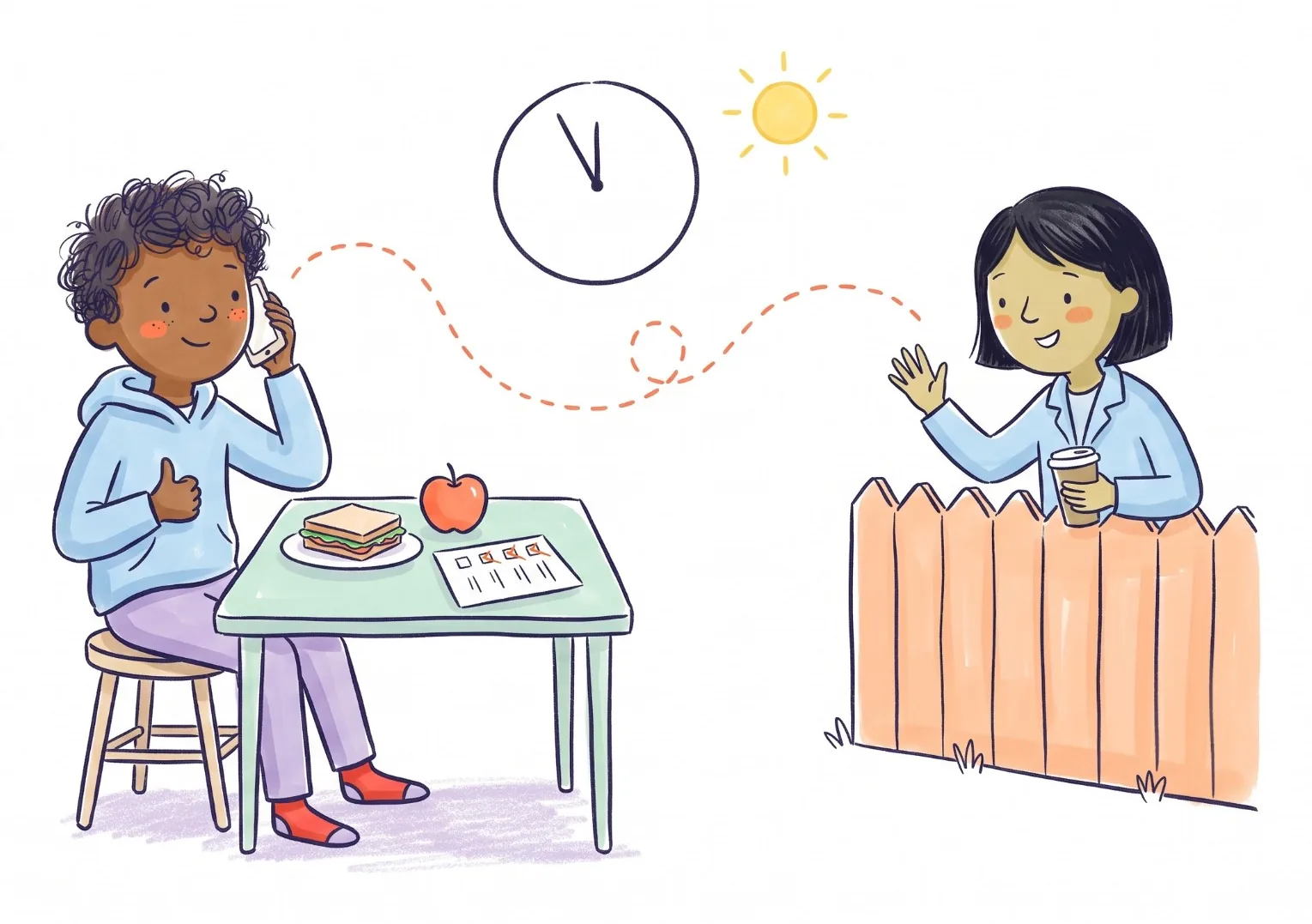
A 12-year-old who's fine from 3:15 to 5:00 is not automatically fine from 8:00 to 5:30. The official guidance we could find says so plainly: it gives hours, not just ages, and for a 12-year-old those hours are short. Georgia's guidelines allow up to twelve hours from 13, and the Canada Safety Council puts a whole day at 15 or 16. For a younger child on a PD day or over winter break, the workable answer is usually part of the day alone and the rest with someone.
Laws and guidelines differ by place, and this is general information, not legal advice. Our home-alone lookup by state and province has the law or official guideline for every US state, DC and Canadian province and territory, each with its source.
How long the guidance says, by age
The after-school hour is what most home-alone advice is written for, and our guide to how old a child can stay home alone covers it. A full day is a separate question, and the agencies that answer it put numbers on time as well as age:
| Source | 9 to 12 | 13 to 14 | Older |
|---|---|---|---|
| Canada Safety Council | 10 to 12: up to two hours | Up to five hours | 15 to 16: possibly a whole day, parent reachable by phone |
| Durham Children's Aid Society, Ontario | 10 to 12: one to two hours, phone-only contact "generally unacceptable" | Two to five hours, an adult reachable by phone | 15 to 16: a full day |
| Georgia DFCS | Brief periods, under two hours | 13 and older: up to twelve hours | |
| Oklahoma Human Services | Older elementary: one to two hours, daytime | Middle school: up to four hours |
Sources: Canada Safety Council, Durham CAS, Georgia DFCS Lack of Supervision Reference Guide, Oklahoma Human Services.
Minnesota frames it the other way round. Its child protection screening guidelines list when a report about a child left alone may be screened in for a response: ages 8 to 10 left alone for more than three hours, 11 to 13 for more than 12 hours, and 14 to 15 for more than 24 hours (Minnesota DHS, DHS-5144). That's a line for when the agency may get involved, which is not the same as advice that 12 hours is a good idea for an 11-year-old.
The AAP's parenting site says experts typically agree that 11 or 12 is an appropriate age to stay home alone "for a few hours" (HealthyChildren.org). A few hours is a morning, not a day.
So, can a 12-year-old stay home alone all day?
By the guidance above, a full working day is longer than any of it suggests at 12, which tops out around two to four hours.
Where you live adds its own layer. In Ontario, the law covers children under 16: whoever is in charge must make provision for supervision that's "reasonable in the circumstances", which is the question a nine-hour day raises. Manitoba and New Brunswick put their line at under 12. Many US states set no age at all. Check yours in the lookup before you plan around it.
At 13 or 14, a long day sits inside some of the guidance and outside the rest. A 14-year-old with a neighbour home is a different case from a 13-year-old who's never done more than an afternoon.
Splitting the day
For a PD day or a week of winter break, cut the day into pieces that fit the guidance:
- Morning alone, afternoon with someone. You leave at 8:00, Grandma arrives at 12:30 and takes the afternoon.
- Trade days with another family. Your kids go to them on Monday, theirs come to you on Wednesday, and nobody burns a full week of leave.
- A camp or program for the middle of the day. Even a three-hour morning program turns one long stretch into two short ones.
More ways to cover the gap are in winter break childcare for working parents, and grandparents on the school run covers handing over the afternoon.
Run a half day first
HealthyChildren suggests building up gradually and taking a test run. For a long day, that's a half day on a Saturday with the school-day-off rules. If they were bored by 10:30 and calling you by 11, you've learned it before it mattered.
Making a long day work
Check-ins at set times. HealthyChildren's advice is that your child contacts you when they first get home. Over a full day, add fixed times: a text at 10, a call at lunch, a text at 3. If one is missed, you call, then the neighbour knocks.
Lunch without the stove. Oklahoma's guidelines ask whether the child can use household appliances properly, and HealthyChildren says to make sure they've practised with you before using any. If they haven't, plan a lunch that needs no heat: sandwiches made the night before, fruit, a thermos of soup.
Screens and outside. Agree a rough shape: a set task in the morning, screens after lunch, a limit. HealthyChildren's advice is to set rules about who can visit and where your child can go. "Back yard only" and "nobody in the house" are clear. "Be sensible" is not.
The neighbour. Durham CAS says phone-only contact is generally unacceptable at 10 to 12, and Colorado's state guidance asks whether parents have arranged with nearby adults to be available if a problem comes up (CO4Kids). Tell the neighbour the day and the hours, and give your child their number on paper.
Siblings. The Canada Safety Council says a child who can care for themselves may not be able to care for younger siblings. Minnesota's guidelines say children under 11 shouldn't provide child care, and that 11- to 15-year-olds in a child care role come under the same time limits as being left alone. Colorado's guidance warns that leaving even a mature 11-year-old in charge of a toddler, preschooler or kindergartner may be considered neglect.
Numbers on the fridge. You, the other parent, the neighbour, a grandparent, 911. A phone that's flat at 2 p.m. has no numbers in it.
One shared plan for the day
A split day only works if everyone knows which half is theirs, and the 12:30 handover is what gets forgotten when Grandma thought it was Thursday.
In Kid Pickup, the 12:30 handover goes on the family calendar as a pickup, and it has Grandma's name on it once she taps I'll do it. If nobody has taken it, the parents get a nudge the day before and again a couple of hours out. The 7 p.m. summary the evening before lists tomorrow's pickups and who has each, and when Grandma arrives she taps I'm here and the family is told. Notes on the pickup are where "lunch is in the fridge, no stove, back yard only" lives, and whoever is coming sees them. Emergency contacts are visible to everyone in the family.
Kid Pickup doesn't track anyone's location, so the check-in call is still how you know your child is fine at 10.
FAQ
Can a 12 year old stay home alone all day?
Most of the official guidance we found says not for a full working day. The Canada Safety Council suggests up to two hours at 10 to 12, Georgia's DFCS under two hours until 13, and Oklahoma up to four hours for middle schoolers. Splitting the day, with a grandparent, neighbour or another family taking part of it, fits the guidance better.
How many hours can a 13 year old be left alone?
It depends on the source. The Canada Safety Council suggests up to five hours at 13 to 14, Durham Children's Aid two to five hours with an adult reachable by phone, and Georgia's DFCS up to twelve hours from 13. Check your own state or province, and build up to a long day.
Can I leave my kids home alone during winter break?
For part of the day, often yes, if they're old enough and ready. A whole day is a longer stretch than most guidance allows before the teens, and a younger sibling raises the bar again. One way to cover it is a mix: a morning alone, an afternoon with a grandparent, and a day traded with another family.
Can my 12 year old babysit a younger sibling all day?
Be careful. Minnesota's guidelines say a child minding others comes under the same time limits as being left alone, and Colorado's state guidance warns that leaving even a mature 11-year-old in charge of a toddler or kindergartner may be considered neglect. The Canada Safety Council notes that a child ready to be alone may not be ready to care for others.
Is there a law about how long a child can be home alone?
We didn't find a law that sets hours. Some states and agencies publish guidelines with hours by age, such as Georgia, Oklahoma and Minnesota, and Ontario's law asks for supervision that's reasonable in the circumstances for children under 16. Our lookup lists the law or official guideline for every state and province, with sources.