
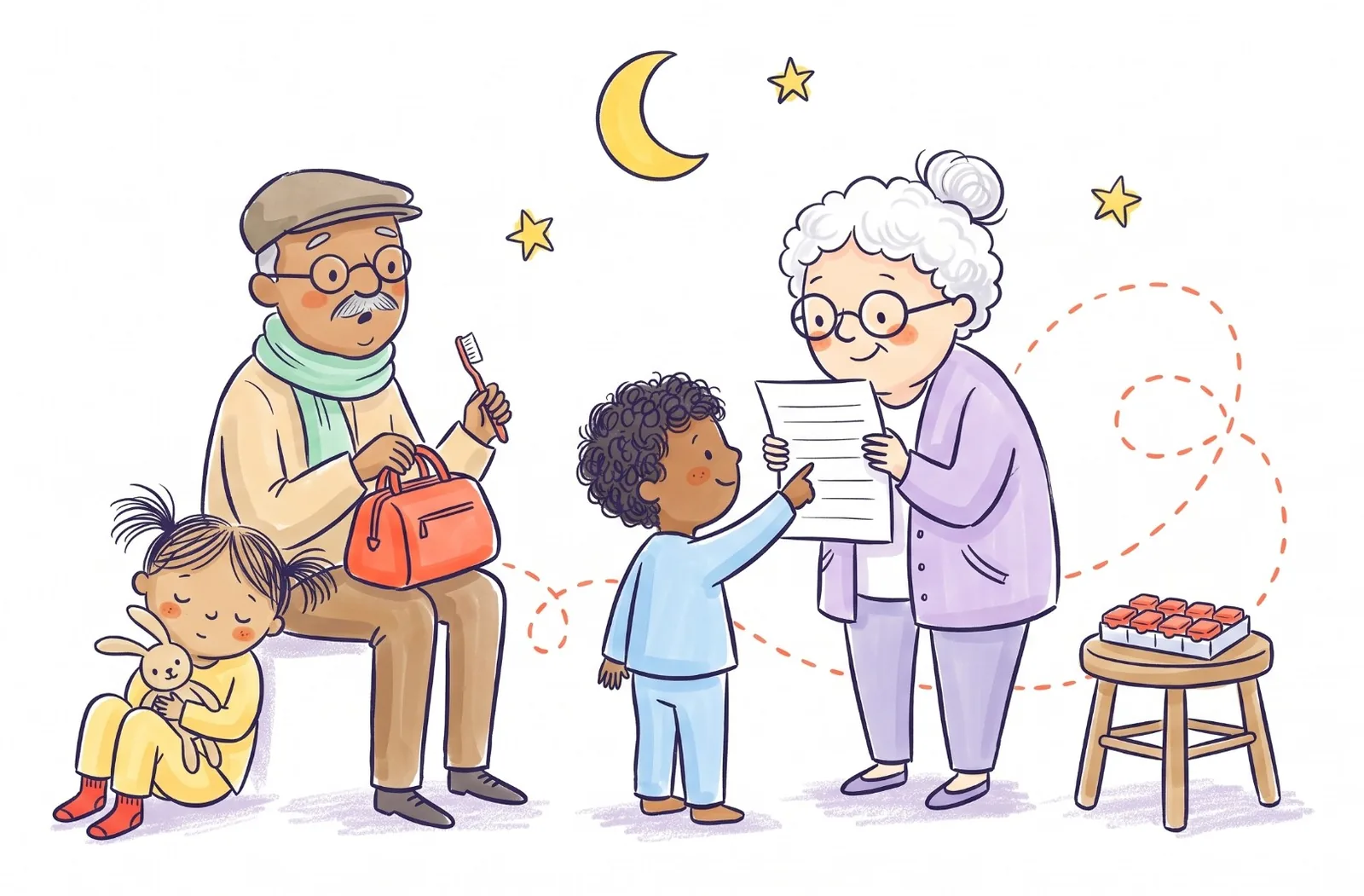
Friday, 5:40 p.m., on Grandma's front step. One overnight bag, one backpack, a booster under your arm, and a list of things you meant to tell her that you'll remember somewhere on the highway. She has raised children. She does not need a lecture. She does need the things only you know: what the five-year-old takes for his ears and how much, which snack has nuts in it, and what she's allowed to sign if somebody ends up at urgent care on Saturday.
This is the list to write down before a night or a weekend at the grandparents', or before they move into your place while you travel. It's longer than a babysitter's sheet for one evening, because a night away has a bedtime, a morning, possibly a school run, and enough hours for something to go wrong. The free babysitter information sheet is a good place to start, and the sections below cover what a one-page sheet doesn't.
Medicine, written out in full
"He has the pink stuff at bedtime" is how a dose gets doubled. For every medicine, write the name on the bottle, the dose in mL or tablets, the time, and what it's for. Then write when the last dose was given before you left, so nobody guesses whether tonight's is due.
Leave the dosing syringe or cup that came with it. The American Academy of Pediatrics says to use the dropper, syringe, cup or dosing spoon that comes with the medicine and never household spoons, which vary in size, and suggests asking the pharmacist to write the instructions down on paper (HealthyChildren.org).
Add two more lines while you're at it. The AAP's babysitter advice is to leave each child's date of birth and approximate weight in case a medical professional needs them (HealthyChildren.org). "About 40 pounds, I think" is not what you want said on the phone to a nurse.
Allergies get their own line, with what happens and what to do. If there's an auto-injector, show where it is and how it works, and say which snacks in Grandpa's cupboard are off limits.
Sleep, and the baby especially
For older kids, write bedtime the way it actually goes: the book, the light left on, what happens if they wake at 2 a.m. and want you.
For a baby, write the safe sleep rules down even if it feels awkward to hand them to the person who raised you. The AAP's current guidance is back to sleep for every nap and every night, a firm, flat surface, and nothing soft in the sleep space: no blankets, pillows, stuffed toys or bumpers. The risk of a sleep-related death is up to 67 times higher when a baby sleeps with someone on a couch, soft armchair or cushion, and a baby who falls asleep in a car seat, stroller or swing should be moved to a firm sleep surface on their back as soon as possible (HealthyChildren.org).
The Public Health Agency of Canada says the same, and two of its lines fit a night at the grandparents' exactly: sofas, armchairs, air mattresses and adult beds "are not made for babies to sleep on", and parents should make sure a baby has a safe sleep space when sleeping away from home. It also asks parents to share the advice with everyone who looks after the baby (Public Health Agency of Canada). If Grandma doesn't have a crib or bassinet, bring the travel cot.
If a doctor is needed while you're away
In an emergency, consent is not supposed to hold anything up. The AAP's policy is that a medical screening exam, and any care needed to prevent imminent and significant harm to a child with an emergency condition, "should never be withheld or delayed because of problems with obtaining consent" (AAP, Pediatrics, 2011). SickKids in Toronto says the same from the Canadian side: every reasonable effort is made to reach the parent, and if treatment can't wait, the team can decide to go ahead without consent (AboutKidsHealth). So Grandma goes, and you keep your phone on.
Non-urgent care, like an ear infection on Saturday morning, is different. Whether a grandparent can consent to that depends on where you live and on the clinic. The AAP's guidance to paediatricians on consent by proxy names grandparents among the adults who bring children in, says doctors need to know their own state's rules, and recommends each practice set one policy and have families fill in consent forms ahead of time (HealthyChildren.org, 2017). Ask your own doctor's office whether they have one, and sign it before the weekend, not during it.
Some places have a legal form. California's Caregiver's Authorization Affidavit lets a relative caregiver, which includes grandparents, authorize a child's medical and dental care; it needs no notary and no court stamp, and a provider who relies on it in good faith is protected (California Family Code form, San Mateo Superior Court copy; Sacramento County Public Law Library). It's written for a child who lives in the caregiver's home, though, so it fits a grandparent raising a grandchild better than a weekend sleepover. In Canada we couldn't find a provincial form for a short stay. A signed letter naming the grandparent, your numbers and the child's doctor costs nothing and gives the clinic something to go on, but ask the clinic what it accepts.
Cards and copies
Leave a photo or photocopy of each child's health card in Canada, or insurance card in the US, plus the family doctor's name and number and the nearest children's hospital or urgent care. Put both poison numbers on the list: in the US the Poison Help line is 1-800-222-1222 (HealthyChildren.org), and in Canada 1-844-764-7669 reaches your local poison centre from anywhere except Quebec, which uses 1-800-463-5060 (Health Canada).
The babysitter information sheet covers most of this on one page: both parents' numbers, emergency contacts, the doctor, each child's allergies and bedtime, and the day's pickups. You fill it in on screen and print it; it runs in your browser, stores nothing and needs no sign-up. For a weekend, write the medicine times on the back.
A quick look around Grandma's house
The medicine your kids are most likely to find at the grandparents' isn't theirs. In a 2014 Safe Kids Worldwide report on emergency visits for medicine poisoning, a child had got into a grandparent's medicine 38 percent of the time, and about 28 percent of grandparents who care for grandchildren every day kept their medicines in easy-open containers (Safe Kids Worldwide). The CDC says finding and swallowing medicine without an adult watching is the main cause of emergency visits for medicine problems in children five and under (CDC).
The weekly pill organizer on the kitchen table is the usual suspect. The CDC-partnered Up and Away campaign says to check whether a pill organizer is child-resistant, because many aren't and young children can open them easily, and to keep purses, bags and coats with medicine in them up and out of sight (Up and Away). Ask kindly, and offer to help move things to a high shelf for the weekend. It's an easy thing to stop noticing once your own kids are grown.
The drive and the school run
If they're driving, agree on the booster and the coat before the first trip; car seat rules when someone else drives has the detail. If the stay includes a school day, Grandma needs to be on the school's pickup list, carry ID, and know the door, the time and the after-school plan. Grandparents on the school run covers the rest, and the school pickup authorization note is there if the school wants something in writing.
When the weekend has pickups in it
A printed sheet can't tell Grandpa that Saturday's swim moved to 10:30, or tell you he's dropped them off. In Kid Pickup, grandparents see the whole family calendar by default, and each pickup carries his name once he taps "I'll do it". The notes on each pickup ("booster's in the hall, coat off before buckling") show to whoever is doing it, and you can attach a file to an event, such as a photo of the signed consent letter. Emergency contacts are visible to everyone in the family, so they're on Grandma's phone at the gate. When he taps "I'm here" and "Picked up", you find out from the airport. Grandparents don't pay for their accounts.
FAQ
What should I leave for grandparents babysitting overnight?
Each medicine written out with the dose in mL, the time and the last dose given, plus the dosing syringe. Allergies and what to do about them, bedtime and morning routines, each child's date of birth and approximate weight, health or insurance card copies, the doctor's number, the poison centre number and your own numbers and where you'll be.
Can a grandparent take my child to the doctor without me?
In an emergency, yes: the AAP says emergency care should never be delayed because consent is hard to get. For non-urgent care it depends on your state or province and on the clinic, so ask your doctor's office whether it has a consent form and sign it before you leave. In California, a relative caregiver the child lives with can use the Caregiver's Authorization Affidavit.
Do I need a notarized medical consent form for grandparents?
Not usually for a short stay, and California's Caregiver's Authorization Affidavit says it needs no notary. What matters is whether the clinic will accept it, so ask your own doctor's office what they want. A signed letter naming the grandparent, the dates, your numbers and the child's doctor is a sensible minimum.
Can my baby sleep in bed with Grandma?
Paediatric advice says no. The AAP says babies should sleep on their back on a firm, flat surface with nothing soft around them, and the risk of a sleep-related death is up to 67 times higher on a couch or soft armchair with someone. The Public Health Agency of Canada says adult beds aren't made for babies to sleep on, so bring a travel cot if there's no crib.
How do I childproof Grandma's house for a visit?
Start with medicine. Ask about pill organizers and easy-open bottles, move them and any purses or bags with medicine in them up high and out of sight, and save the poison centre number in their phone. In the US that's 1-800-222-1222; in Canada, 1-844-764-7669 outside Quebec.