
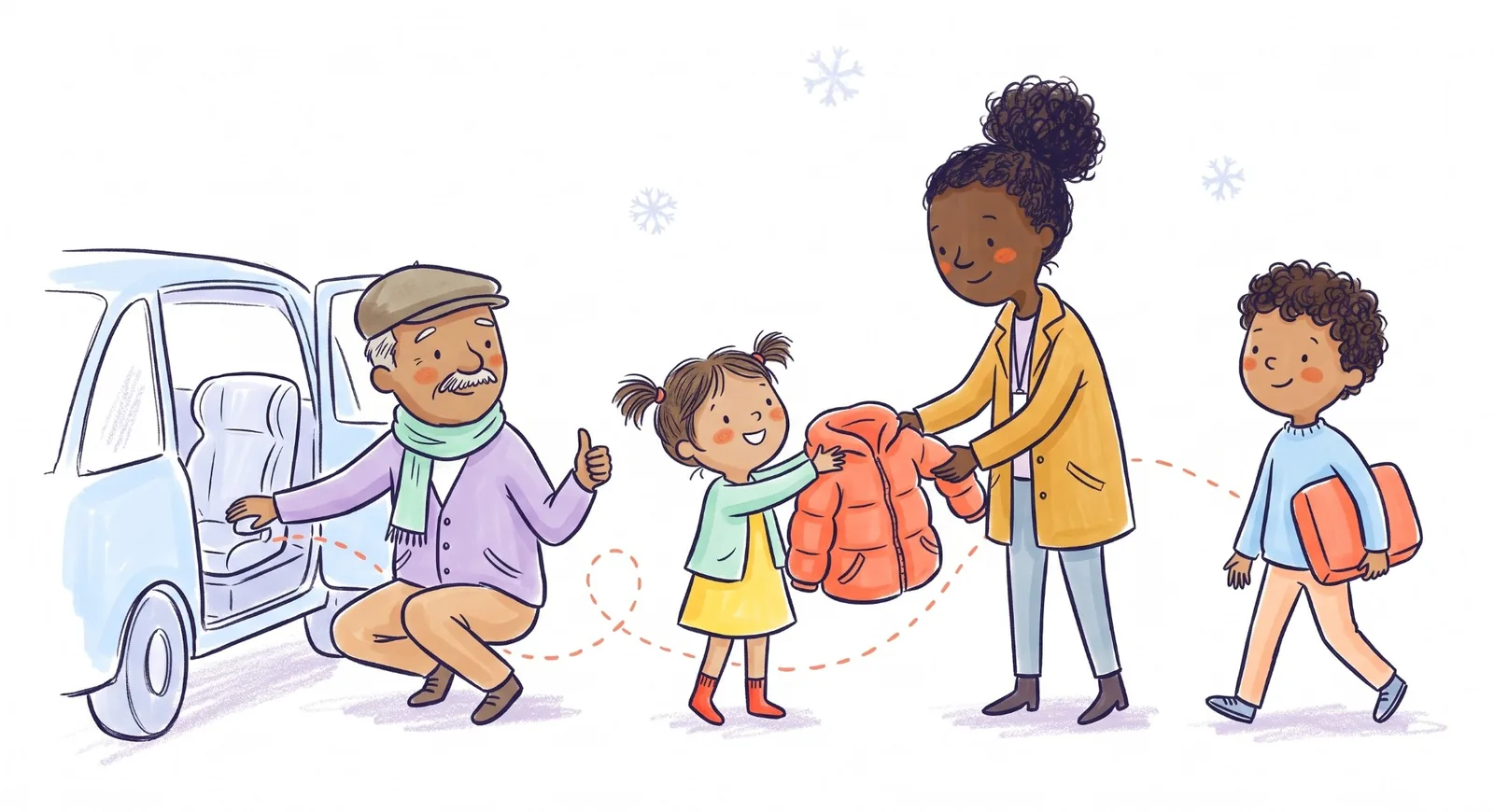
Three things to settle before Grandma, the sitter or the other carpool parent drives your child this winter: whose booster seat is in whose car, that the puffy coat comes off before the harness goes on, and that the rule is the same for every driver, not just you. Everything else in this post is detail.
The reason it needs saying is that the rules slip exactly when someone else is behind the wheel. In a national survey of parents of four- to eight-year-olds, 79% said they would always ask another driver to use a booster for their child, but only 55% always used one when driving other people's kids who didn't have their own (Macy et al., Pediatrics, 2012). A Safe Kids survey two years later found one in five carpooling parents admitted to bending the rules when they drove, 61% had noticed other drivers doing it, and 21% rarely or never talked to the carpool driver about what seat their child uses (Safe Kids Worldwide, 2014). Those numbers are old because nobody has asked since. There's no reason to think they've improved.
Who needs what seat
Age is the wrong measure. The American Academy of Pediatrics says a child stays in a booster until the adult belt fits properly, which is typically at about 4 feet 9 inches and somewhere between 8 and 12 years old, and every child under 13 rides in the back (HealthyChildren.org). The Canadian Paediatric Society puts the same line at 145 cm and says for most children that's between 9 and 12 (Caring for Kids). In the UK the law is a child seat until 12 years or 135 cm, whichever comes first (GOV.UK).
Most families move on too early. AAA's review of 91,618 seat inspections in 2024 found nearly 23% of children had moved to a booster too soon and more than 89% had moved to a seat belt too soon (AAA, 2025). Seven in ten parents in the Safe Kids survey didn't know the 4-foot-9 figure at all. So if your eight-year-old is in a booster and the other parent's eight-year-old isn't, you're probably the one who's right, and the conversation is worth having anyway.
The booster matters. Children aged 4 to 8 in belt-positioning boosters are 45% less likely to be injured in a crash than children in seat belts alone (IIHS). The CDC's advice is the same: buckle every child, on every trip, in the right seat for their size (CDC).
The law is on the driver, not the parent
This is the part carpooling parents get wrong. Child restraint laws bind whoever is driving. Michigan's statute is typical: "each driver transporting a child in a motor vehicle shall properly secure that child in a child restraint system", with a booster until the child is 4 feet 9 inches or eight years old (Michigan Compiled Laws 257.710d). There is no exception for somebody else's child. Every US state has a child passenger safety law, and the age and size at which a child can move to a belt differs by state (GHSA, October 2025); each Canadian province and territory sets its own age, height and weight rules too (Transport Canada).
So when Grandma drives your six-year-old home without a booster, it's Grandma who gets the ticket. Framing it that way takes the sting out of asking. You're not telling her she's a bad driver. You're making sure she doesn't get fined on your account.
The puffy coat problem
Cold weather is what turns a correctly used seat into an unsafe one, and it's the piece every winter driver needs told. The AAP's advice is that bulky clothing, including winter coats and snowsuits, should not be worn underneath the harness of a car seat, because in a crash the fluffy padding flattens out from the force and leaves extra space under the harness (HealthyChildren.org). The Canadian Paediatric Society says the same: bulky clothing or snowsuits should not be worn in the car seat (Caring for Kids). Transport Canada's warning about padded seat covers describes the mechanism: extra padding adds slack and compressibility, and the slack means the harness can't hold the child properly (Transport Canada).
There's a test anyone can do in the driveway. Buckle the child in with the coat on and tighten the harness until you can't pinch any of the strap. Unbuckle, take the coat off, buckle again without adjusting anything. If you can now pinch the webbing, the coat is too thick to wear under the harness (Consumer Reports, January 2026). The fixes are the same everywhere: coat off, buckle, then the coat goes on backwards over the harness like a blanket, or a blanket goes over the top, or the child wears thin fleece layers in the car and the big coat waits in the footwell.
For a child in a booster the stakes are lower, because the adult belt sits over the coat the same way it does for a grown-up, but a thick coat still lifts the lap belt off the hips. Take it off if you can.
What to agree with each driver
Keep it short and the same for everyone. For a grandparent, a sitter or another family:
- Which seat, and where it lives. A spare backless booster is the cheapest piece of safety kit you'll buy, and it solves the whole problem for a regular driver. For a carpool, agree whose booster rides in whose car on which day, or send the child with theirs (a backless booster fits in a backpack). Nearly half of all restraints in a NHTSA observation study were misused in some way, but boosters were the exception, at about 20%, and the common mistake was the lap belt sitting in the wrong place (NHTSA, 2015). Show the driver once: lap belt low across the hips, shoulder belt across the collarbone, not the neck.
- Coat off before the harness. Say it once, out loud. It's the rule that's changed most since we were kids.
- Back seat until 13. Even for the ten-minute hop from school, and even when the front is free.
- No bending the rules for a short trip. The school run is short by definition, and "it's just around the corner" is how one in five carpool drivers in the Safe Kids survey ended up with unbuckled kids.
- For a Canadian grandparent bringing a US seat across the border, or the other way: a seat used in Canada needs Transport Canada's National Safety Mark, and it's illegal to use one that doesn't have it (Transport Canada). Borrow a local one instead.
If a carpool parent won't use a booster for your child, that's a carpool you don't join. The carpool schedule guide has the other rules worth agreeing before anyone drives, and grandparents on the school run covers the rest of handing pickup to a grandparent. The babysitter information sheet has a line for the car seat; fill it in.
Keeping track of who's driving
The seat conversation only works if you know who's driving before they pull up, which is the job Kid Pickup does. Every pickup on the shared calendar has one name on it, so Thursday says Grandma, Friday says Dana from the carpool, and you can see on Wednesday night that the booster needs to move cars. The notes on the pickup are where "Lily's booster is in the hall, coat off before buckling" lives, and whoever has that pickup sees them.
Ask a grandparent or a sitter by name and they get a notification with I'll do it and Can't make it. If nobody has taken a pickup, the app nudges the parents the day before and again a couple of hours out, which is how you avoid the 2:45 scramble that ends with whoever's free driving without a booster. Grandparents and sitters don't pay, and Kid Pickup is free for two weeks on iPhone for new subscribers.
FAQ
Does my child need a booster seat in someone else's car?
Yes, the same as in yours. Child restraint laws apply to whoever is driving, and the safety case doesn't change with the car. Keep a spare booster for regular drivers, or send a backless booster with your child for a carpool.
Who gets the ticket if my child isn't in a car seat in a carpool?
The driver. Michigan's law, like most, says each driver transporting a child must properly secure that child, with no exception for other people's children. Every US state and Canadian province has its own child passenger law, and the ages and heights differ, so check yours.
Can kids wear winter coats in car seats?
Not under a harness. The AAP and the Canadian Paediatric Society both say bulky coats and snowsuits shouldn't be worn in a car seat, because the padding compresses in a crash and leaves the harness loose. Buckle first, then put the coat on backwards over the straps or use a blanket. Thin fleece layers are fine.
How do I know if a coat is too puffy for a car seat?
Buckle your child in with the coat on and tighten the harness until you can't pinch any strap. Take the coat off and buckle again without adjusting. If you can pinch the strap now, the coat is too thick to wear under the harness.
When can a child stop using a booster seat?
When the adult seat belt fits: lap belt low on the hips, shoulder belt across the collarbone, back against the seat with knees bent at the edge. That's usually around 4 feet 9 inches (145 cm), between 8 and 12 years old. In the UK the law is 12 years or 135 cm, whichever comes first. Children under 13 ride in the back.
How do I ask a grandparent to use a car seat without offending them?
Make it about the law and the car, not their driving: "The booster's in the hall, and the rule's on the driver here, so I don't want you getting a ticket for us." Show them the pinch test once and put the coat rule in writing where they'll see it before each pickup.