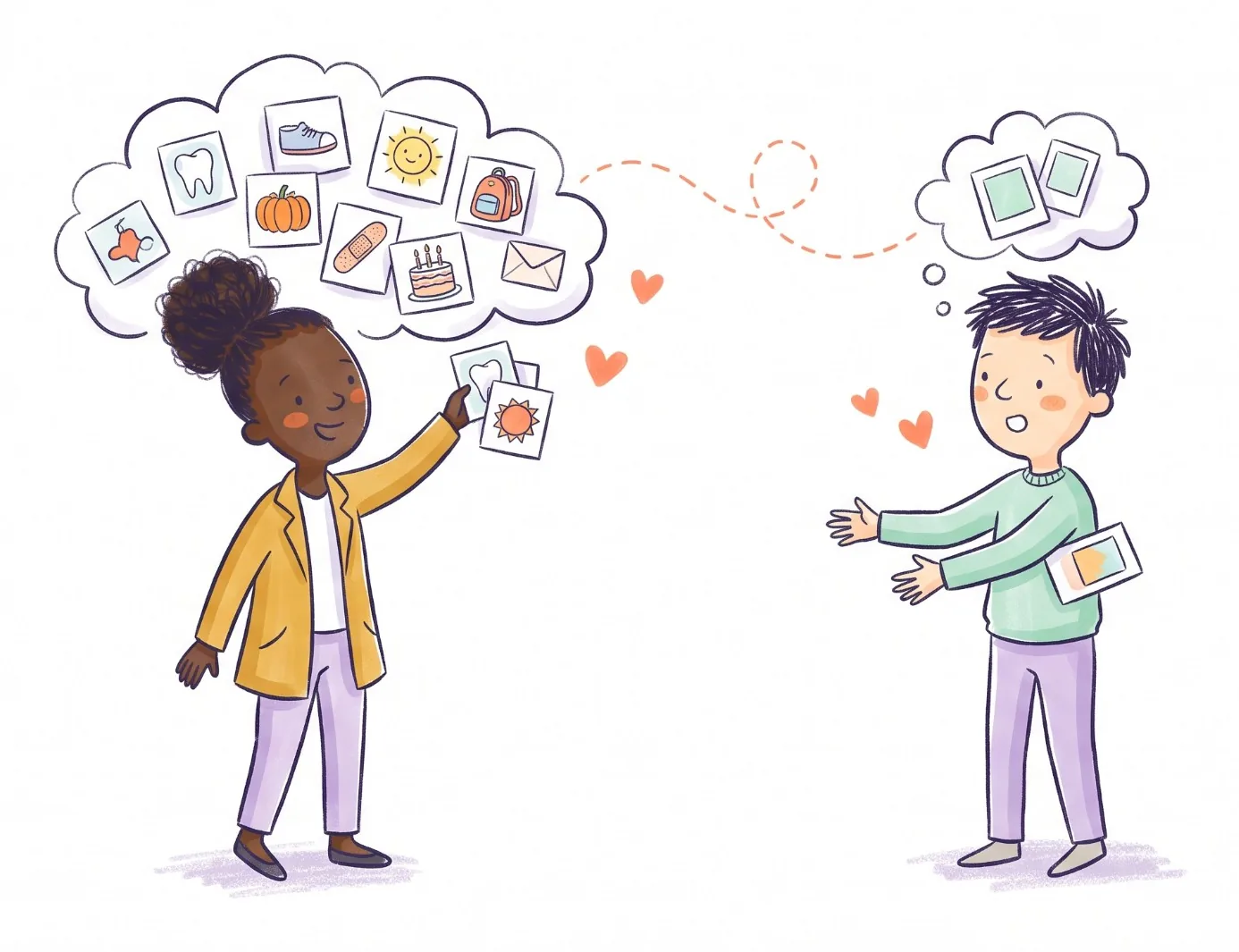
The school texts at 1:40: there's a lice letter going home, and could someone pick up the forgotten library book. Your partner doesn't get the text. Your partner doesn't know the library book exists. You know about it, the dentist on the 14th, the swim fees, and the fact that Thursday is early dismissal. You'd like to know less in 2027.
This is a resolution worth making, and the research on resolutions says a lot about how to make it one that lasts past January.
Do New Year's resolutions actually fail?
Less often than you've been told. The two figures that do the rounds every December, "80% fail by February" and "only 8% of people keep them", don't trace back to any study we could open.
What the studies do say:
- Pew Research asked Americans three weeks into 2024. Of those who'd made a resolution, "59% say they have kept all of them so far, while 28% say they have kept some of them" (Pew Research Center).
- John Norcross followed 159 resolvers for six months and found "46% of the resolvers were continuously successful compared to 4% of the nonresolvers" (Norcross et al., 2002). His earlier study of 200 people found 77% still at it after a week, and 19% after two years (Norcross & Vangarelli, 1988).
So most resolutions fade, but slowly, and the people who make one do far better than the people who mean to change "at some point". Pew also found that relationships were the third most common subject: 57% of resolvers made one about personal relationships. Who carries the family calendar is one of those.
Why one parent ends up knowing everything
It usually isn't a decision. One person answered the first email from daycare, so the second one came to them too. Five years later they're the one the school calls.
The numbers from 2024 to 2026 show how common that is:
- In US couples where both parents work full time, Pew found in March 2026 that "52% say the mom does more of the day-to-day parenting tasks. Only 10% say the dad does more" (Pew Research Center, 2026).
- The same survey asked who leaves work when a child is sick or childcare falls through: "48% say the mom would be more likely to take unexpected time off". Seven in ten said who has the more flexible job is a major factor.
- A 2024 study of 322 mothers of young children found they were responsible for "72.57% of all cognitive labor", the noticing, planning and remembering, against their partners' 27.43% (Aviv et al., 2024).
That last study has the finding that matters for a resolution. Mothers who carried more of the thinking reported more stress, burnout and depressive symptoms. How the physical chores were split didn't show the same link. It's a snapshot of one group at one time, so it can't prove cause, but it fits what a lot of parents say: doing the drive is fine; being the only one who knows the drive exists is the tiring part.
If you want the background on how one parent becomes the default, our post on the default parent goes through it, and the mental load list breaks the thinking into its four stages.
Make it a "start" resolution, not a "stop" one
"Stop being the only one who knows the schedule" names something to get away from. A Swedish study that followed 1,066 people through 2017 found that people with goals to move towards did better than people with goals to avoid something: 58.9% considered themselves successful after a year, against 47.1% (Oscarsson et al., 2020). The effect was small and people rated their own success, but it costs nothing to use.
So turn it round. Some examples:
- "From January, Sam owns Thursdays: drop-off, pickup, and anything the school sends about them."
- "Swim lessons are Priya's: the fees, the bag, the schedule changes, the pickup."
- "Every Sunday night we both look at the week and say who's doing what."
Each of those is something that happens, not something that stops happening.
Hand over whole jobs
The useful word in those examples is "owns". Doing Thursday's pickup when reminded still leaves you doing the remembering. Owning Thursdays means the school emails, the early dismissal and the "can Grandma do it this week?" all belong to the other person.
There's early evidence for this. In 2025 the USC team behind the cognitive labour study tested an online version of the Fair Play method, where couples give each other whole tasks, with 87 mothers of preschoolers. Those who got further through it reported a more even split afterwards, and those whose split of the thinking improved reported less depression and stress (Aviv et al., 2025). It was a small pilot with no comparison group, and the authors say it needs repeating with more families. Still, it's the best study we found on handing the thinking over.
Research on fathers' parental leave points the same way. A German study found that fathers did more housework later mainly after longer leaves, or leave taken while their partner was back at work (Bünning, 2015). Being in charge alone, with nobody to ask, is what changes the habit.
What that looks like on an ordinary week:
- Pick jobs with edges. A day of the week, one child's activity, or one kind of task (every dentist and doctor appointment). "Help more with pickups" has no edges.
- Hand over the inputs too. Add their email to the school's list, the team app and the daycare contacts. If the news still only comes to you, the job is still yours.
- Let it be done their way. If you check behind them, you're still holding it.
- Expect a slip. In Norcross's two-year study, "Fifty-three percent of the successful group experienced at least one slip". A missed form in February isn't the end of the plan.
Pick one person to check in with
In the Swedish study, people who named somebody to support them through the year, and got a short check-in each month, did better than those who were left alone (62.3% against 55.9%, a small effect). For a family that support person is usually the other parent, and the check-in can be the Sunday look at the week.
Keep it short: ten minutes, the week ahead, who has each pickup, anything that's changed. If a grandparent or sitter is part of the week, they need to know their days too. Our Sunday planning routine has a template.
Write it where both of you see it
A plan that lives in one person's head or one person's phone is still one person's plan. It has to be somewhere everyone involved can see it, and it has to say who, not just when.
That's the part Kid Pickup was built for. Each pickup, drop-off and activity goes on a calendar the whole family shares, and each one shows who's doing it or that nobody has it yet. You can ask someone by name, and they answer from the notification with "I'll do it" or "Can't make it", so nobody has to chase. It doesn't make anyone own Thursdays. That part is a conversation. It just means the answer to "who's got Thursday?" isn't you by default.
Kid Pickup is on iPhone. New subscribers get two weeks free on any plan (Apple charges the plan's price when they end unless you cancel at least 24 hours before).
FAQ
What is a good New Year's resolution for parents?
One that's specific and has an owner, such as "my partner takes every Thursday pickup and everything the school sends about it". Research on resolutions suggests goals to start something do a little better than goals to stop something.
What percentage of New Year's resolutions fail?
There's no single figure. In Norcross's studies, 46% of resolvers were still on track at six months and 19% after two years. The popular "80% fail by February" and "8% succeed" figures don't trace to a published study we could find.
How do I get my partner to take on more of the mental load?
Hand over whole jobs with clear edges, such as one day of the week or one child's activity, including the emails and contacts that come with them. Then leave them to it, and check in once a week rather than every day.
Why does one parent always end up doing the planning?
Usually by accident: one person took the first call or email and kept getting the rest. In 2026, Pew found that in US couples where both parents work full time, the mother more often does the day-to-day parenting tasks and more often takes time off when childcare falls through.
Does sharing a family calendar help with the mental load?
It helps everyone see the plan, which is a start. We found no study that tests calendars themselves. What the research does support is giving whole tasks to one person, so the calendar works best when it shows who owns each pickup.
How long does it take for a new family routine to stick?
In the best-known habit study, people took anywhere from 18 to 254 days to reach their peak automaticity, and a single missed day made no real difference. Plan for a few months, not a few weeks.