
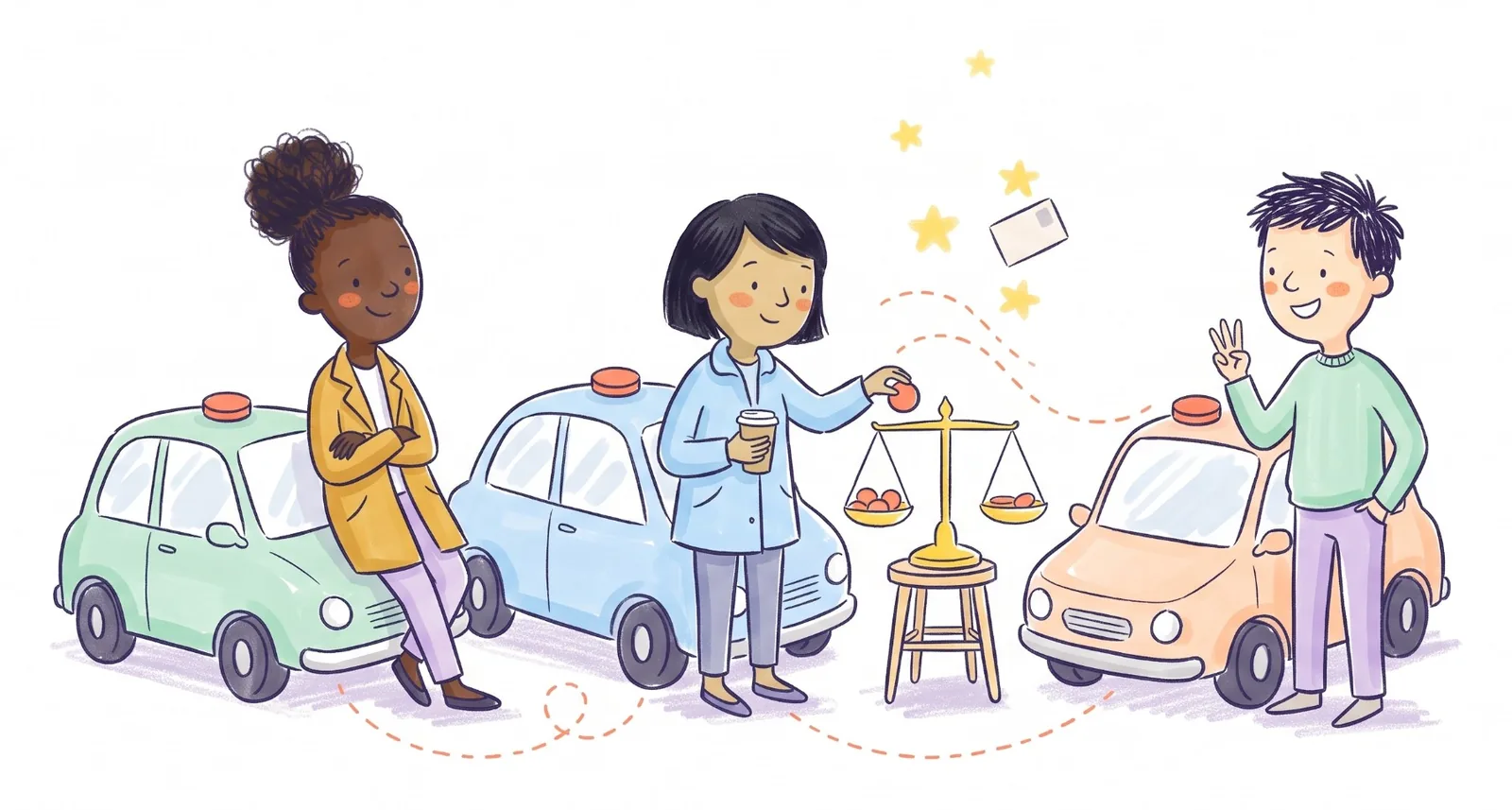
Count trips, not days. Give every family the same number of drives over a few weeks, work around the days each one can never do, rotate the awkward days so nobody owns Friday forever, and write swaps down. If some drives are much longer than others, agree as a group whether they count double before the first one, not after.
Setting a carpool up is covered in our guide to setting up a carpool schedule. This post is about the arguments that come after, and a rule for each.
Count trips, not days
"Each family takes a day" is how many carpools start, and it's where the unfairness hides. With four families and five school days, someone gets two days or Friday floats. If you do drop-off and pick-up, a day is two trips, and a family that only does mornings does half the work of one that does both.
So the unit is one drive: one car, one direction, one time. Over four or eight weeks every family should end up within one drive of every other. A family that can never do Tuesdays is fine: they do their share on other days, and the totals still match.
Two more rules make it feel fair as well as be fair. Don't give one family both halves of the same day unless there's no other way, because a 7:45 drop-off and a 3:15 pickup on one Thursday is a whole day gone. And rotate, so the same family isn't on Friday afternoon every week of the term.
The carpool rotation generator does it: add the families, tick the days each can't drive, choose the carpool days, drop-off, pick-up or both, and how many weeks (up to eight). It counts trips, avoids giving one family both halves of a day where it can, and shows each family's drive count at the bottom so you can check everyone is within one. It runs in your browser with no sign-up, and nothing is saved. Print it, or download it and open it in Google Sheets for the group.
Three kids and one kid
The family with three kids fills three seats every day. The family with one fills one, and gets the same service.
The group should pick one of two honest answers. Count drives: everyone drives equally, whatever they send. Simple, and the easiest to keep going. Count seats: your share of drives matches your share of kids, so with eight kids and three of them yours, you do about three drives in eight. Fairer on paper, but it falls apart the first time a child is off sick.
A middle path that works: equal drives, and the bigger family takes the ones nobody wants, like the early Monday or the Friday that runs long. Whatever you choose, put it in the first message. An unspoken rule is one that only the person who feels short-changed remembers.
The two-seater, and the family with no car
The American Academy of Pediatrics says "all children younger than 13 years should ride in the back seat" (HealthyChildren.org), so a two-seater takes no kids at all.
Take them out of the driving rotation and agree what they cover instead: walking the group home when the school is close, being the backup for a missed pickup, hosting after school while parents finish work, or more of the gas money. The car seat post covers whose booster lives in whose car, which decides how many seats a car really has.
Long drives and short ones
A five-minute school run and a 25-minute drive to the rink are both "one drive" in a simple count. If your carpool covers both, the group can weight them: a school run counts as one, anything over about 20 minutes each way counts as two, and you balance points instead of trips.
The generator counts every drive as one, so weight it afterwards: mark the long drives on the printout and trade a long one for two short ones until the points come out even. Keep it to two weights. A five-level points system is a spreadsheet nobody maintains past Halloween.
The swap ledger
Somebody has the dentist, someone else covers, and nobody writes it down. Three months later one parent has covered six times and been covered twice, and both remember it differently.
Keep a ledger, as a tab in the shared sheet or a pinned note in the group chat:
| Date | Should have driven | Actually drove | Paid back on |
|---|---|---|---|
| Tue 3 Nov, pick-up | Family A | Family C | Thu 19 Nov |
| Fri 13 Nov, drop-off | Family B | Family A |
The rule: a swap is paid back within four weeks, on a day the family who covered picks. An empty cell older than a month is visible to everyone, so nobody has to raise it. A driver who doesn't show at all is a different problem, and what to do when the carpool driver doesn't show up covers the first fifteen minutes.
Gas money
Plenty of carpools never discuss money, which is fine until one family lives further out or owns the only car big enough for practice. If you settle up, pick one published figure and stop debating it. AAA's 2025 Your Driving Costs study puts fuel for an average new car at 13 cents a mile, with regular gas averaging $3.151 a gallon over the year to May 2025, and the full cost of owning and running one at 77 cents a mile at 15,000 miles a year (AAA, 2025). A 10-mile round trip is about $1.30 in gas, or $7.70 at full cost.
Some groups borrow a tax rate because it's easy to find. The IRS business rate is 76 cents a mile from July to December 2026 (IRS). In Canada, the 2026 limit on tax-exempt car allowances that employers can deduct is 73 cents a kilometre for the first 5,000 km in the provinces (Department of Finance Canada). Neither was made for a school run, and both are generous for one. Settle up monthly: nobody wants a $1.30 e-transfer at 3:20.
Holiday Mondays
In the US, five of the eleven federal holidays are set by law on a Monday (5 U.S.C. 6103). In Canada, Victoria Day, Labour Day and Thanksgiving fall on Mondays too (Canada Revenue Agency). If your school closes for them and one family always has Monday, that family drives less all year without anyone noticing.
Counting trips over a term instead of a week fixes most of it. The generator doesn't know your school calendar, so when a holiday wipes out a drive, cross it off and log it as owed in the ledger. Pro-D days and early dismissals work the same way.
Keeping track of whose turn it is
A fair rotation on paper still needs each parent to know it's their turn. In Kid Pickup, each drive goes on a shared calendar with one name on it once that parent taps "I'll do it", and a repeating drive like every Tuesday pickup is set up once. Invite the other carpool parents as helpers and ask them by name; they get "I'll do it" and "Can't make it" buttons. If a drive still has nobody, the app nudges the parents the day before and again a couple of hours out, and school days off show on the calendar, which helps when you're working out who owes a Monday.
FAQ
How do you split a carpool fairly?
Count trips, not days, so every family does the same number of drives over a few weeks. Work around the days each family can never drive, rotate the awkward days so nobody always gets Friday, and keep a swap ledger so covered drives get paid back.
Should a family with more kids drive more often?
The group should decide once, in writing. Equal drives for everyone is simplest and easiest to keep going. Matching drives to the number of kids is fairer on paper but breaks down with sick days. A middle path is equal drives, with the bigger family taking the drives nobody wants.
How much gas money should carpool parents pay?
Pick one published figure. AAA's 2025 study puts fuel at about 13 cents a mile, or 77 cents a mile for the full cost of owning and running a new car. The IRS business rate (76 cents a mile from July 2026) is a tax figure and generous for a school run. Settle up monthly, not per trip.
What if a carpool parent keeps swapping and never pays it back?
Keep a swap ledger the whole group can see: the date, who should have driven, who did, and when it was paid back. Agree swaps are repaid within four weeks. An open entry from last month is then visible to everyone, so nobody has to bring it up.
How do you handle long drives in a carpool rotation?
If the group agrees, weight them: a short school run counts as one drive, anything over about 20 minutes each way counts as two. Balance the points instead of the trips, and keep it to two weights so the sheet stays simple.
What about families who can't drive?
Take them out of the driving rotation and agree what they cover instead: walking the group home, backing up a missed pickup, hosting after school, or more of the gas money. Children under 13 belong in the back seat, so a two-seater can't take kids.