
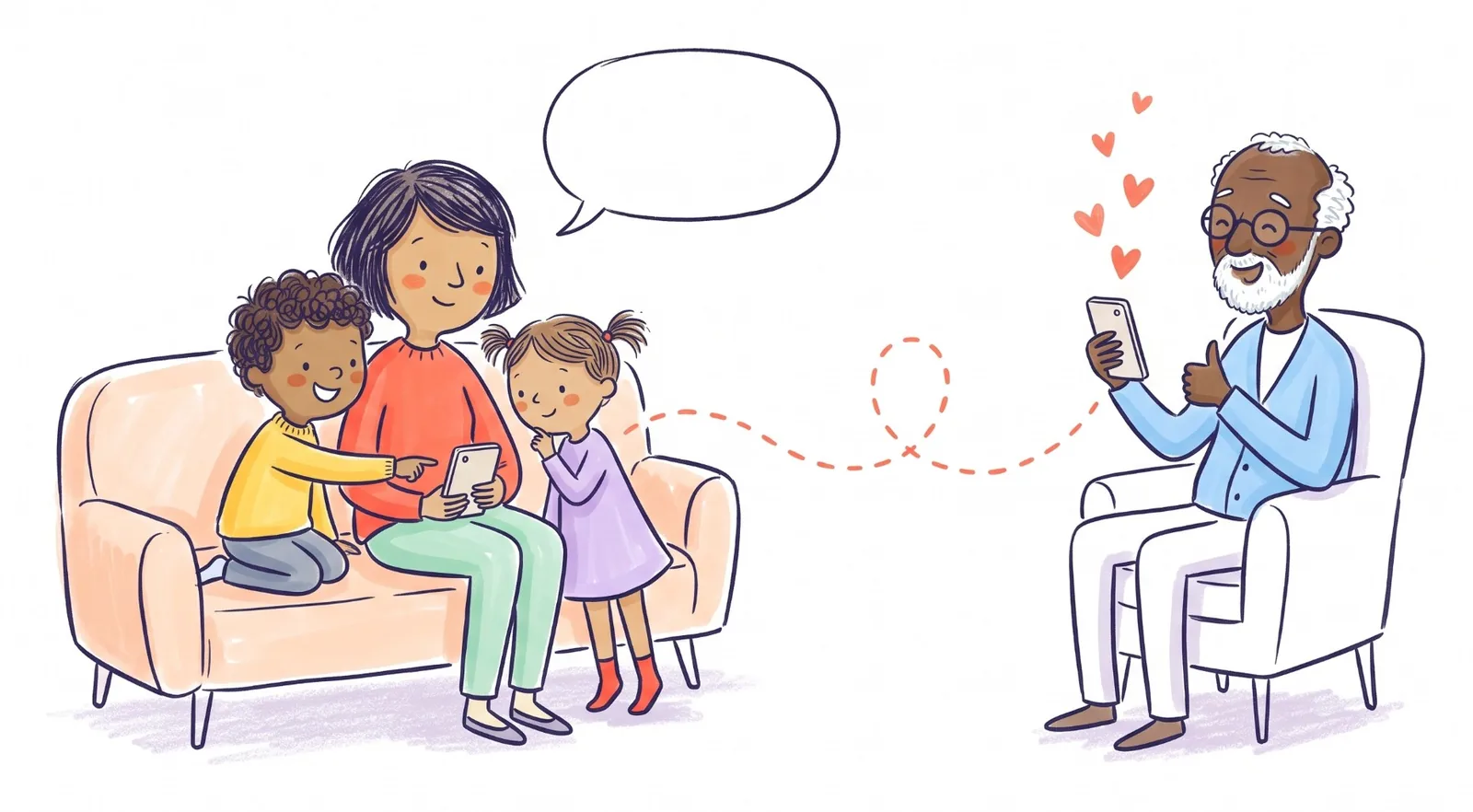
Most children see a feed years before they're allowed one. They watch a parent scroll in the car line, they lean over a grandparent's shoulder at the kitchen table, and by nine or ten a good number have an account of their own that nobody signed off on. The first time they post something, react to something or read a comment about themselves, it's usually on a platform built for adults, with strangers in the room and a recommendation engine deciding what they see next.
There's a better first place, and most families already have one: the group where the grandparents, the other parent and the sitter swap photos of the kids. If that group is private, and if the child is in on it, it's a working model of how posting works, with the stakes set to zero. This post is about using it that way, and about what "private" has to mean for it to be safe.
The gap between the first account and the first lesson
The American Psychological Association's 2023 health advisory on adolescent social media use puts it plainly: adolescents' social media use "should be preceded by training in social media literacy" (APA, 2023). It also says features like the like button, recommended content and endless scrolling should be tailored to what a young user can handle, which in practice no major platform does.
The training is supposed to come first. For most kids it doesn't come at all, and the account comes early. In the last full Common Sense census of tweens and teens, 38% of 8- to 12-year-olds had used social media, in a world where every major platform says you have to be 13 (Common Sense Media, 2021). About three in ten 8- and 9-year-olds had their own phone. By the teenage years it's near universal: the US Surgeon General's 2023 advisory reports that up to 95% of 13- to 17-year-olds use a social media platform, a third of them "almost constantly" (HHS). Pew's 2025 survey of teens found 36% use at least one platform almost constantly, led by TikTok (Pew Research Center, December 2025).
So the question for a parent of an eight-year-old isn't whether to teach this. It's where. The usual answer is a talk, and a talk about something a child has never done lands about as well as a talk about driving does at seven. Common Sense Media's own readiness guide suggests, for ages 7 to 9, sharing a family account so they can practise under supervision (Common Sense Media). Good idea. Doing it on a shared Instagram still means doing it on Instagram.
What a child learns from the family's feed
Set up properly, a private family feed teaches the same handful of things a public one does, minus the audience. Our family feed page lists the lessons one by one. The short version, as it plays out at home:
A post is a decision. The child picks the photo, decides what to say about it and watches it go out to Grandma, Grandpa, Dad and Lucía the sitter. Then it's there. Tomorrow it's still there. Nothing about a public platform teaches that better than watching your own post sit in a list that your grandmother reads.
A reaction is a reply, not a score. On a feed where eight people can react and nobody can see a running count against anybody else, a heart from Grandma means Grandma liked it. That's all a like was ever supposed to mean. A child who learns it there has something to compare against when they meet the version where the number is the point.
A comment is a conversation you're in, not about. "Who taught you that flip?" from an uncle is a comment the child can read and answer with a parent beside them. They learn what it feels like to be commented on before anyone unkind gets the chance.
You ask before you post somebody. The child who gets asked "can I put this one up for Grandma?" learns that the question exists, and starts asking it about their friends and their siblings. Asking permission before sharing a photo, learned at six.
Some things don't go up. Where the house is. The school's name on the gate. The friend who isn't yours to post. In a family feed the reason can be explained in a sentence, because everybody reading is somebody the child knows.
Deleting is possible, and limited. A post can come down. The people who saw it still saw it. That's a lesson every adult on social media wishes they'd had at eight.
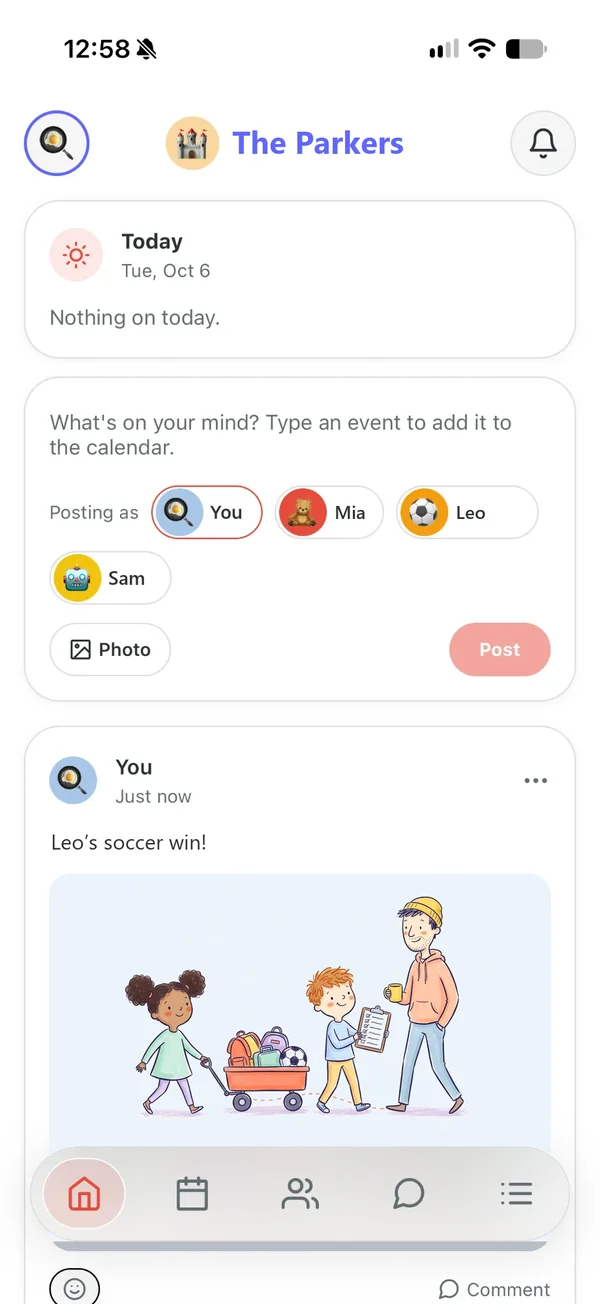
None of this needs a child to have an account. In Kid Pickup, children don't have one: a parent or guardian posts on the child's behalf, the post shows the child's name with "via Ash" under it, and the child never signs in to anything. The practice is real, and nobody outside the family sees it.
Why "private" has to be more than a setting
"No ads, no algorithm" is on the box of most family photo apps now, and it's the right promise. It's also easy to say and hard to check, so this is what it has to mean in practice, and what to look for in any app, ours included.
Who can see it is a fixed list. Not "friends of friends", not "anyone with the link", not a setting that drifts after an update. In Kid Pickup the feed is visible to the people in your family's group and nobody else: the owner, the other parent or guardian, and the grandparents, sitters and helpers you've invited. There are no public profiles and no public links to a post, so there's nothing to find.
Nothing ranks or recommends. The feed is newest first, every time, for everyone. Nobody's post is promoted, buried, or followed by something a machine thinks you'd like. A child using it learns what a feed looks like when it's just the posts, in order, which is a thing most adults have forgotten.
No ads, and no ad business behind it. Kid Pickup is paid for by the subscription. There is no advertiser to serve and no reason to study what anybody looks at.
Nothing reads the photos. This is the new one, and it matters. In 2026 the complaint about family photos moved from "who can see them" to "what's being done with them". When Google Photos added a feature that reads the faces in your library and generates new AI images of the people in it, a widely shared post from a parent who kept being shown AI pictures of their kids drew hundreds of replies from parents describing the same thing (PhotoWorkout, July 2026). Kid Pickup's assistant, a Premium feature, reads your calendar to answer questions about the week. It never sees the feed. No post, photo or comment in the feed is sent to any AI model, by us or by anyone we use. Photos are shrunk on the phone before upload, which also strips the camera's location data, and they're stored in private storage that only the people in your family can open.
Deleting means deleting. A deleted post leaves the feed at once and is removed from our servers after 30 days. Our privacy policy says so, and the app's Privacy screen says the same.
If an app you're considering can't answer those five in writing, the lesson you'd be teaching your child is the wrong one.
The thing this replaces: posting your kids to everyone
Most parents aren't choosing between a private feed and nothing. They're choosing between a private feed and the one they already use. The research on that habit, usually called sharenting, has been consistent for a decade and got sharper this year.
The Children's Commissioner for England worked out in 2018 that by the age of 13 a child's parents have posted, on average, about 1,300 photos and videos of them, and cited a Barclays forecast that by 2030 sharenting would account for two-thirds of identity fraud against young adults (Children's Commissioner, 2018). The kids have a view on it: in a Microsoft survey across 25 countries, 42% of teenagers said they had a problem with their parents posting about them (Microsoft, 2019). And parents can see it in each other: in the Mott Children's Hospital poll, 74% of parents on social media knew another parent who had shared too much about a child, including half who'd given away something that could identify where the child was (C.S. Mott Children's Hospital, 2015).
In July 2026 the UK's National Crime Agency and the Internet Watch Foundation issued guidance for parents because photos of children posted online were being altered into abuse material by AI tools. Their advice to parents who still want to share online: create a "close friends" group, check your privacy settings, and talk to your child about how they feel about their photos being shared (National Crime Agency, July 2026). The American Academy of Pediatrics says the same from the other side of the Atlantic: ask children's permission before sharing their images, and share with a select group rather than everyone (AAP Center of Excellence on Social Media, 2026).
A "close friends" list on a public platform is the minimum. A feed that was never public, in an app with no advertiser and no stranger in it, is the same advice carried through. It also happens to be the better classroom, because the child can be in it.
Why children don't get accounts, and shouldn't yet
The law has been drawing the same line for years, and it's getting firmer. In the US, COPPA applies to any online service directed at children under 13 that collects their personal information (FTC), which is why every major platform sets 13 as the floor. Australia went further: since 10 December 2025, age-restricted platforms there have to take reasonable steps to stop anyone under 16 from holding an account (eSafety Commissioner). Florida passed a law barring accounts under 14 and requires parental consent at 14 and 15 (Florida Statutes 501.1736).
Those laws are about platforms. The point for a family is simpler: a child doesn't need a login to learn how posting works. They need a grown-up with one, a feed that's safe to practise in, and a seat beside them. Kid Pickup is built around that. Children are profiles with a name, a colour and a picture, never users. Nothing is collected from a child, nobody signs in as one, and a post in a child's name always carries the grown-up's.
A plan by age
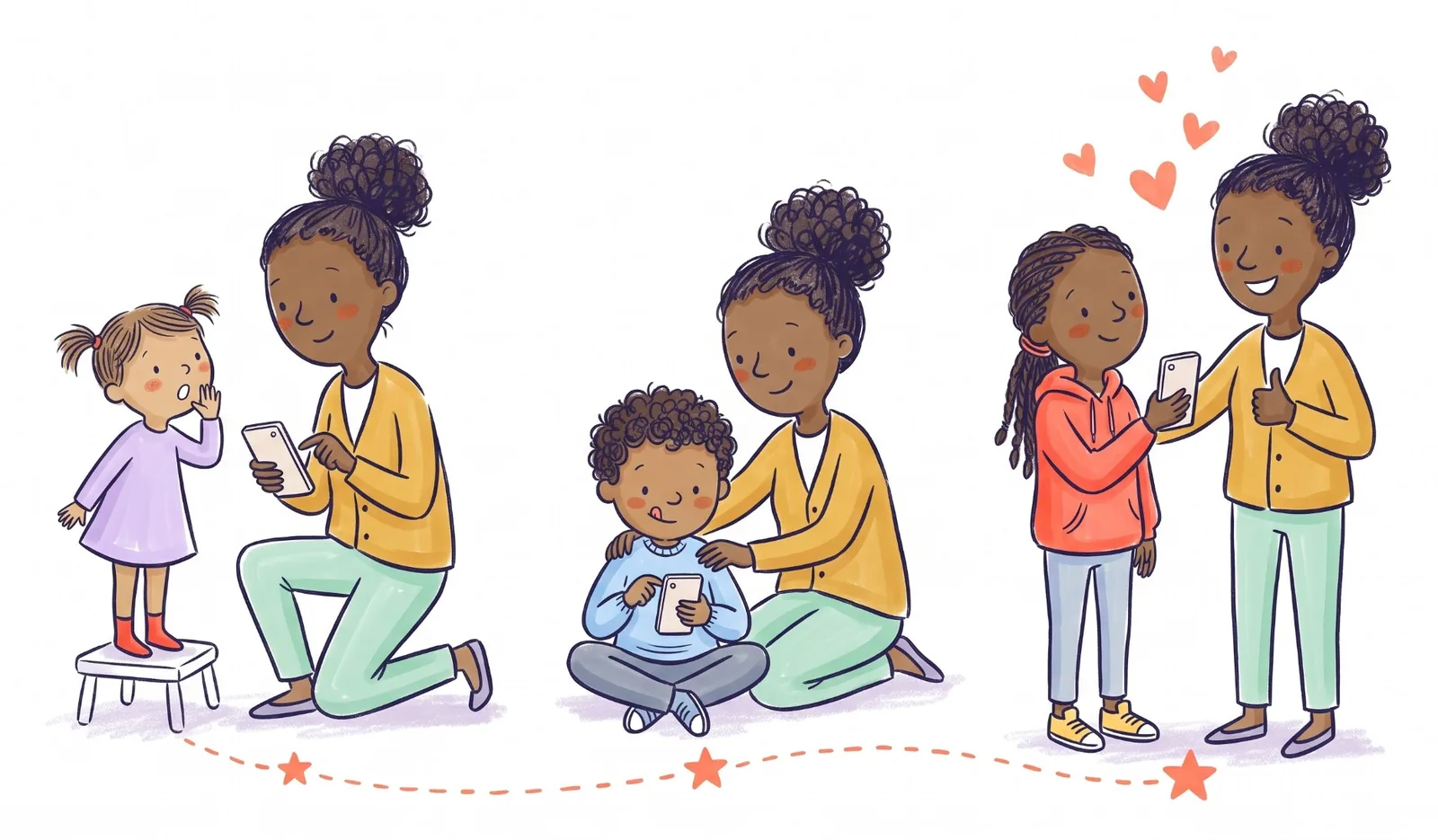
Five to seven: they dictate, you type. "Grandma, I did the monkey bars." Read the reactions out loud together the next day. The lesson is that a post goes to real people who answer.
Eight to ten: they choose and write, you post. Let them pick the photo and the words. Ask the two questions every time, out loud, until they ask them first: is everyone in this picture okay with it going up, and is there anything in it that says where we are? Let them see a post get deleted once, and talk about who already saw it.
Eleven and twelve: they run it, you watch. Hand them the phone for the feed with you in the room. Talk about what a reaction count would do to the same post if a thousand strangers could see it. Internet Matters' advice to seek a child's permission before posting as they get older goes both ways here: by now they should be the one deciding what goes up about them (Internet Matters).
Before thirteen: the readiness conversation. Common Sense Media's guide has the questions to ask about whether a child is ready for an account of their own. By then a child who has spent four years posting to their grandparents, with a parent beside them, has an answer to most of them.
The feed in Kid Pickup
Kid Pickup is a family coordination app, and its Home feed is where the day's pickups and the family's photos live together. Everyone in the family group sees it, grandparents and sitters included. Posts are newest first with nothing ranked or promoted, up to three photos each, eight reactions and one per person, comments underneath, and no ads anywhere. You can edit your own post and only your own; a parent or guardian can take any post down; anybody can report one. A parent can post as a child, with "via" and their own name under it, and no child ever has a login. Nothing in the feed is read by any AI. The feed has its own notification switch, so a quiet Sunday stays quiet. The family feed page has the full comparison against Facebook, Instagram and the photo-sharing apps.
Grandparents and sitters don't pay, and Kid Pickup is free for two weeks on iPhone for new subscribers.
FAQ
Is it safe to post pictures of my kids online?
On a public platform the honest answer is that you can't know who sees them or what's done with them, and in 2026 UK police guidance told parents to share only with a close friends group for that reason. On a private feed where every member is someone you invited, with no public links and no advertiser, the only people who see them are the family members you invited.
What is sharenting and why does it matter?
Sharenting is parents posting about their children online. By 13 the average child in one UK study had about 1,300 photos and videos posted by their parents, 42% of teenagers in a 25-country survey said they had a problem with it, and police now warn that public photos of children can be misused by AI tools. Your child also has to live with the record you made.
How do I teach my child about social media before they're old enough to join?
Let them post in a private family feed with you beside them: they choose the photo and the words, you post it in their name, and you read the reactions and comments together. They learn that a post is permanent, that a reaction is a reply from a real person, and to ask before posting anyone else, with nobody outside the family there.
Should a child under 13 have their own social media account?
Every major platform sets 13 as the minimum, which follows US privacy law, and Australia has set 16. A child doesn't need an account to learn how posting works. In Kid Pickup children are profiles, not users: a parent posts for them, and the post shows both names.
What does "no ads, no algorithm" mean in a family photo app?
Nobody outside your invited group can see a post, the feed is newest first with nothing promoted or recommended, there's no advertiser and so no reason to study what you look at, and nothing reads your photos. Ask any app to put those four in writing. Kid Pickup's privacy policy does.
Does Kid Pickup use AI on my family's photos?
No. The Premium assistant reads your calendar to answer questions about the week. No post, photo or comment in the feed is sent to any AI model. Photos are shrunk on the phone before upload, which drops the camera's location data, and are kept in private storage only your family can open.
What happens when I delete a post?
It leaves everyone's feed at once and is removed from Kid Pickup's servers after 30 days. The people who saw it before you deleted it still saw it, which is worth saying to a child at the same time.