
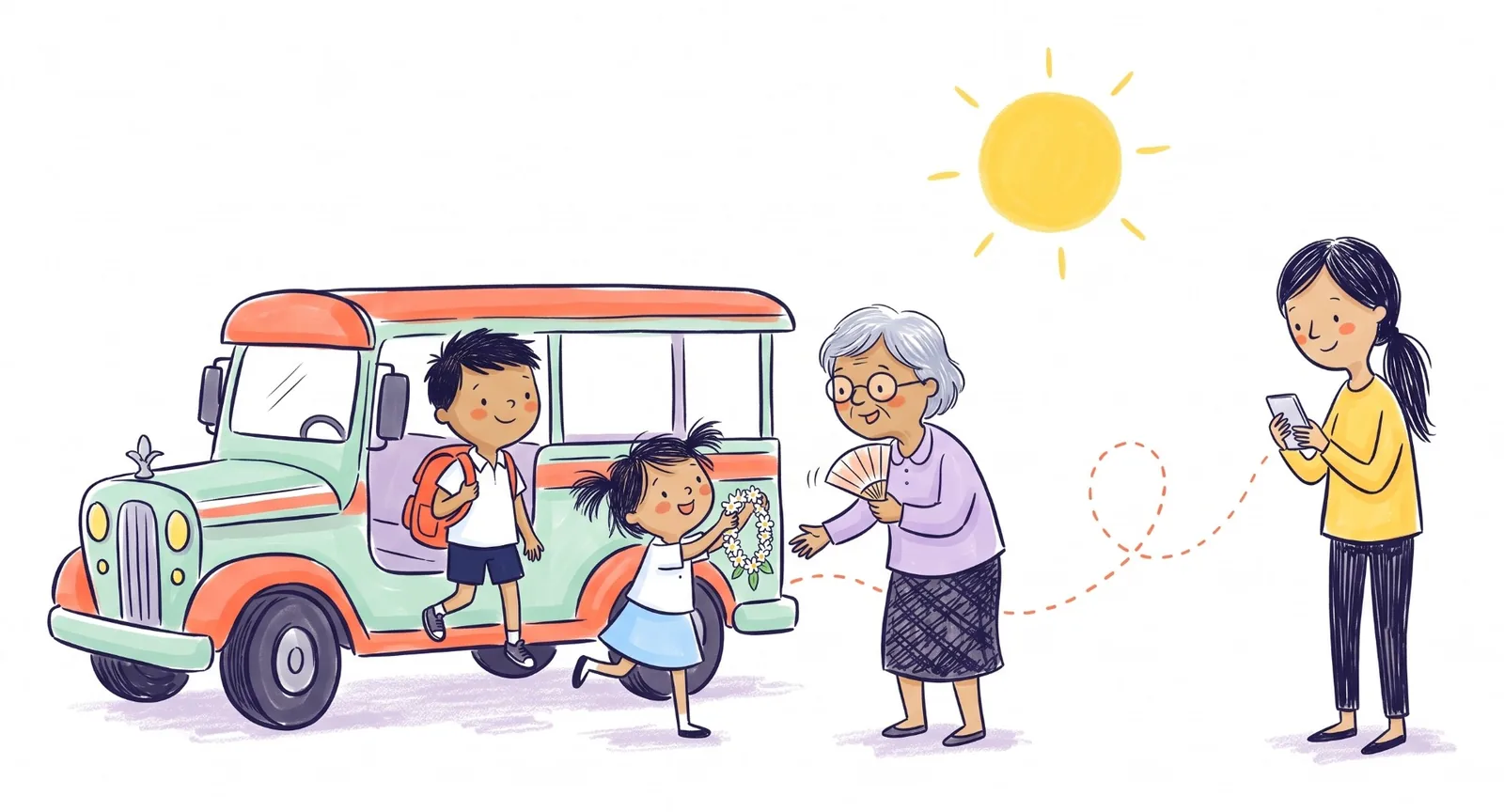
You'll sometimes read that it's illegal in the Philippines to leave a child under seven alone. That's not quite what the law says. The "under seven" comes from the Revised Penal Code's offence of abandoning a child, which is about leaving a child in your custody, not stepping out for an hour. No Philippine law sets an age at which a child can be left at home alone.
What the law does do is make supervision a parent's duty, and neglect a form of child abuse. Below, those laws side by side, plus the rules on car seats, motorcycles and school service vehicles, and who can fetch your child from school.
This is general information, not legal advice.
The laws on leaving a child alone
| Law | What it says |
|---|---|
| Child and Youth Welfare Code (PD 603) | Supervising a child's activities is one of a parent's duties. A child is "unattended" when left "without provisions for his needs and/or without proper supervision". |
| Revised Penal Code, art. 276 | Punishes anyone "who shall abandon a child under seven years of age, the custody of which is incumbent upon him". |
| RA 7610 | Defines child abuse to include neglect, "habitual or not", for anyone under 18. |
PD 603, the Child and Youth Welfare Code
Among a parent's duties, the Code lists "To supervise his activities, including his recreation" (PD 603). It defines an unattended child: "A child is unattended when left by himself without provisions for his needs and/or without proper supervision." And it makes a parent criminally liable if they abandon a child "under such circumstances as to deprive him of the love, care and protection he needs."
The Revised Penal Code
Article 276 punishes anyone "who shall abandon a child under seven years of age, the custody of which is incumbent upon him", with heavier penalties if the child's life is endangered or the child dies (Revised Penal Code). This is the source of the "under seven" figure, and it's about abandonment, not a home-alone age.
RA 7610
The Special Protection of Children Against Abuse, Exploitation and Discrimination Act defines child abuse to include "Psychological and physical abuse, neglect, cruelty, sexual abuse and emotional maltreatment", and covers everyone below 18 (RA 7610).
Put together: there's no minimum age, but leaving a child without proper supervision or without what they need can be neglect under these laws. Most families here never face the question, because a lola, tita or yaya is home. When nobody is, the safe test is whether your child has everything they need and someone they can reach.
To report a concern about a child, call the Makabata Helpline 1383, run by the Council for the Welfare of Children (CWC).
Getting to school
There's no official age for walking or commuting to school alone. The laws that do apply are about vehicles.
In the car. Under the Child Safety in Motor Vehicles Act (RA 11229), "at no instance shall such child be left unaccompanied by an adult in a motor vehicle", even buckled into a car seat. And "No child twelve (12) years and below of age shall be allowed to sit in a front seat of a motor vehicle", unless they meet the height exception of 150 cm (RA 11229).
On a motorcycle. On busy or fast public roads, a child may ride only if their feet reach the foot pegs, their arms reach around the rider's waist, and they wear a standard helmet (RA 10666).
In a school service. The LTFRB's school transport guidelines, from 2004 and the latest we could find, require seatbelts for all passengers, doors only at the rear or right side, NBI or police clearance for drivers and conductors, conductors carrying STOP/GO signs when children cross, and a rear sign reading "SCHOOL SERVICE - CAUTION: CHILDREN CROSSING" (LTFRB guidelines). It's worth asking your school service operator whether it meets them.
Who can fetch your child
DepEd hasn't published a single nationwide rule on who may fetch a pupil at dismissal; schools set their own. The clearest DepEd rule covers off-campus activities: under DepEd Order 66, s. 2017, "Elementary learners shall not be allowed to leave the school premises without their fetchers", and schools must set a waiting area where returning learners wait until their fetcher arrives (DepEd Order 66, s. 2017).
If a yaya fetches your child, she's a kasambahay under the Batas Kasambahay, and "It shall be unlawful to employ any person below fifteen (15) years of age as a domestic worker" (RA 10361).
One more rule, aimed at whoever has charge of a child: the Revised Penal Code penalises anyone in charge of rearing or educating a minor who hands the child "to a public institution or other persons, without the consent of the one who entrusted such child" (Revised Penal Code, art. 277). It's the legal reason schools want to know, in advance and from you, who your child may go home with. Give the school a written list of fetchers.
Who's fetching today?
With school, tutorials and practice, the afternoon often needs a parent, a lola and a yaya, each on different days. Kid Pickup gives every pickup one name. Whoever is fetching taps "I'll do it", and if nobody has, the app sends you a nudge the day before and again on the day. It's on the Philippine App Store.
For support now, see our Philippines crisis and support lines.
FAQ
What is the legal age to leave a child alone in the Philippines?
There isn't one. PD 603 makes supervision a parent's duty and treats a child left without proper supervision or provisions as unattended, and RA 7610 counts neglect as child abuse. The Revised Penal Code's "under seven" applies to abandoning a child, not to a home-alone age.
Can a child sit in the front seat in the Philippines?
Not if they're 12 or younger, under RA 11229, unless they're at least 150 cm tall. A child must also never be left in a vehicle without an adult.
Can a yaya fetch my child from school?
Usually, if you've told the school. Each school sets its own fetcher rules, so give it a written list. A kasambahay must be at least 15.
What are the rules for school service vehicles in the Philippines?
The LTFRB's 2004 guidelines require seatbelts for all passengers, doors only at the rear or right side, police or NBI clearance for drivers and conductors, and a "SCHOOL SERVICE - CAUTION: CHILDREN CROSSING" sign at the back.