
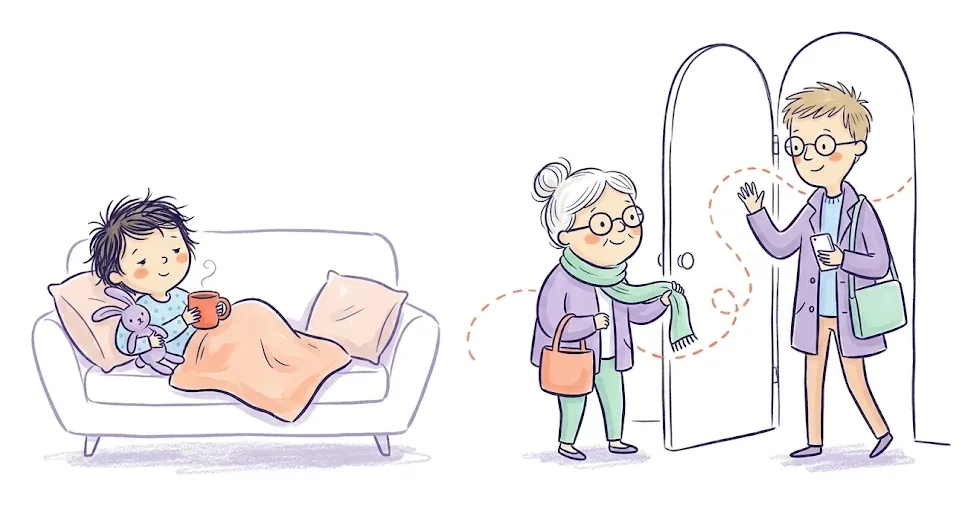
It's 6:40 a.m. Your eight-year-old is on the couch with flushed cheeks and a thermometer that says 101.6. You have a meeting at nine you can't move, your partner leaves at seven, and school starts at 8:30.
Every family with school-age kids goes through this several times a winter. The decisions are the same every time: does she stay home, who stays with her, and who tells everyone else. They're much easier to make the night before, or better still in October, than at 6:40 with a sick child on the couch.
This guide covers both halves: the health rules that decide whether a child stays home, and the plan that decides who covers. It isn't medical advice. Your child's doctor, and your school's own policy, have the final say.
When should I keep my child home from school?
The American Academy of Pediatrics' Council on School Health gives three reasons to keep a child home (HealthyChildren.org):
- A fever above 101°F in the past 24 hours.
- Vomiting or diarrhea in the past 24 hours.
- Not well enough to take part in class.
If none of those apply, the AAP says a child with milder symptoms can go. It also says to follow your school, district or state guidance where it differs, and that your pediatrician is the best person to ask.
How long after a fever can my child go back to school?
The usual rule is 24 hours without a fever, without fever medicine. That last part matters: a child who's fine at 7 a.m. because of a dose of ibuprofen at 6 still has a fever.
Public health guidance says much the same. The CDC's general advice for respiratory illnesses is to return to normal activities once symptoms have been improving overall and there's been no fever, without fever-reducing medicine, for at least 24 hours, then take extra care for five days (CDC). Ottawa Public Health tells families to keep children home until they're fever-free without medicine and their symptoms have been improving for 24 hours (Ottawa Public Health, via OCDSB, Dec 2025).
Why does my school's rule differ from the doctor's?
Because there isn't one rule. Three things vary:
| What you'll see | Where | |
|---|---|---|
| What counts as a fever | 101°F (AAP's stay-home line); 100.4°F or 38°C and up (Children's Hospital of Philadelphia); above 37.9°C rectal or 37.5°C by mouth (Canadian Paediatric Society) | Varies by school and source |
| After vomiting or diarrhea | 24 hours after the last episode | AAP and many US schools |
| 48 hours after the last episode | Ottawa Public Health and many Canadian schools | |
| After a fever | 24 hours fever-free, without medicine | Common in both countries |
The Children's Hospital of Philadelphia calls 100.4°F (38°C) or higher a fever (CHOP). The Canadian Paediatric Society defines a fever as any reading above the normal range for how it was taken: above 37.9°C rectally, or above 37.5°C by mouth or under the arm (Caring for Kids).
So the practical answer is: look up your school's or daycare's illness policy now, before you need it, and go by that. If you're unsure on the day, call your doctor. In BC you can call 8-1-1 (HealthLink BC) and in Ontario 811 (Health811) to talk to a nurse any time.
When to call the doctor straight away: the CPS says a baby under 3 months with a fever should be seen urgently, a baby under 6 months with a fever should see a doctor, and an older child should see one if a fever lasts more than 48 to 72 hours. It also says to contact your health care provider if your child is unusually cranky or irritable, very sleepy or unresponsive, keeps wheezing or coughing, or has a fever with a rash or anything else that worries you.
Who stays home: how do two working parents decide?
In most families, the answer is "Mom, again." In a 2022 KFF survey of working parents, 56% of mothers said they're the one who usually cares for a child who's sick and can't go to school, against 19% of fathers. About half of those who miss work for it aren't paid for that time: 53% of mothers and 49% of fathers (KFF Women's Health Survey).
A fairer way to decide, made once rather than every time:
- Look at the week's calendars, not just today. Whoever has the more movable day takes it, and the other takes the next one.
- Split the day. One parent takes the morning, the other the afternoon. A handoff at lunch costs each of you half a day, not one of you a whole one.
- Keep count. If the same person has taken the last three sick days, the next one isn't theirs, whatever the meetings say.
If you're the one who always ends up home, our post on being the default parent is worth a read.
Can I take time off work to care for a sick child?
It depends on where you work, and short illnesses are where the law is thinnest.
- US federal law: the Family and Medical Leave Act gives eligible employees up to 12 weeks of unpaid, job-protected leave a year, including to care for a child with a serious health condition. It applies to private employers with 50 or more employees, and you need at least 12 months and 1,250 hours on the job (US Department of Labor). It's built for serious illness, so for a day of the flu, look at your employer's sick leave policy and any paid sick leave law in your state or city.
- Ontario: most employees get up to three days of unpaid, job-protected family responsibility leave a year after two weeks on the job, and a child's illness is covered. Your employer can ask for reasonable evidence, but can't require a doctor's note (Ontario).
- BC: up to five days of unpaid family responsibility leave a year to help with the care, health or education of a child under 19. BC's five paid sick days are for your own illness or injury (BC Employment Standards).
- Elsewhere in Canada: check your province's employment standards, or the Canada Labour Code if your employer is federally regulated. Our snow day plan covers the federal rules.
Your employer's own policy may be more generous than the law. It's worth reading it in October, not at 6:40 on a Tuesday.
Your backup childcare plan for sick days
A sick child can't go to daycare, school, the after-school program or, usually, a friend's house. So the backup list for a sick day is shorter than for a snow day, and it's worth writing down now.
| Who | Good for | Ask now |
|---|---|---|
| A parent, the whole day | Very sick kids, a doctor's visit | Which days each of you can most easily move |
| Two parents, half a day each | Most sick days | Where and when the lunchtime handoff happens |
| A grandparent or relative | A child who's on the mend and mostly resting | Are they happy to look after a sick child? Some aren't, especially in flu season |
| Your sitter or nanny | Families with a regular sitter | Do they cover sick days, and at what rate? |
| Employer backup care | If your employer offers it | Does it cover sick children? Many services don't |
| Working from home | Older kids who'll rest on the couch | Does your manager know that's the plan? |
Put names in order: Plan A, Plan B, Plan C. When Plan A says "I can't today", the next text goes to Plan B straight away, not to the group chat.
What if the school calls at 11 a.m.?
The call nobody plans for: "She's got a temperature, can someone come and get her?" Schools want a sick child collected quickly, so the answer can't wait for a group chat.
Decide now:
- Who goes first, and who goes if they can't. Usually it's whoever is closest, not whoever the school called.
- Who is on the school's list. The person who picks her up has to be someone the school will release her to. Our guide to who can pick up your child from school and the free pickup authorization letter cover this.
- Where she goes after. If Grandma collects her, can she stay at Grandma's until 5?
The sick-night checklist
When a child goes to bed looking flushed, take five minutes:
- Check your school's or daycare's illness policy (fever, and vomiting: 24 or 48 hours?).
- Agree who stays home tomorrow if they're sick, and who's Plan B and Plan C.
- Message Plan B tonight: "Lily might be sick tomorrow. Could you be on standby?"
- Decide who handles tomorrow's pickups and activities if plans change.
- Have the school's absence line or app ready.
- Write your work message now, so it's one tap in the morning.
- Note the time and dose of any fever medicine, so you know when the 24 hours really started.
Telling everyone at once
A sick day changes plans for everybody: the pickup someone had, the soccer practice, the sitter coming at 3. Kid Pickup keeps all of it in one place:
- Call off what isn't happening. Open today's pickup and call it off, with Someone's unwell as the reason. Whoever had it is told, so nobody drives to school for a child who's at home.
- Ask for help once. Tap Request Help with a note ("Lily's home sick, can anyone sit with her from 1?"), and everyone who could help gets a "Can you help?" notification with an I'll do it button. The first yes puts their name on it. (How Request Help works.)
- Add the doctor's appointment as an event, and share it with Grandma if she's the one taking her.
- One message to the whole circle in the family chat, so the other parent, Grandma and the sitter all know at once.
Kid Pickup is on iPhone with a 14-day free trial, and grandparents and sitters never pay.
FAQ
When should I keep my child home from school?
The American Academy of Pediatrics says to keep a child home if they've had a fever above 101°F or vomiting or diarrhea in the past 24 hours, or if they aren't well enough to take part in class. Follow your school's own policy where it differs, and ask your pediatrician if you're unsure.
How long does my child need to be fever-free before going back to school?
Most schools ask for 24 hours without a fever, without fever-reducing medicine like acetaminophen or ibuprofen. A child whose temperature is normal only because of medicine still has a fever. Check your school's policy for its exact rule.
Can my child go to school after vomiting?
Usually not for a while. The AAP and many US schools say 24 hours after the last episode; Ottawa Public Health and many Canadian schools say 48 hours. Your school's or daycare's illness policy decides.
Can my employer ask for a doctor's note when my child is sick?
It depends on where you work. In Ontario, an employer can ask for reasonable evidence for family responsibility leave but can't require a note from a health professional. In the US and other provinces, it depends on your employer's policy and local law.
Does FMLA cover a sick child?
The FMLA covers caring for a child with a serious health condition, for eligible employees at employers with 50 or more staff. For a short illness like a cold or a stomach bug, your employer's sick leave policy and any state or local paid sick leave law are more likely to help.