
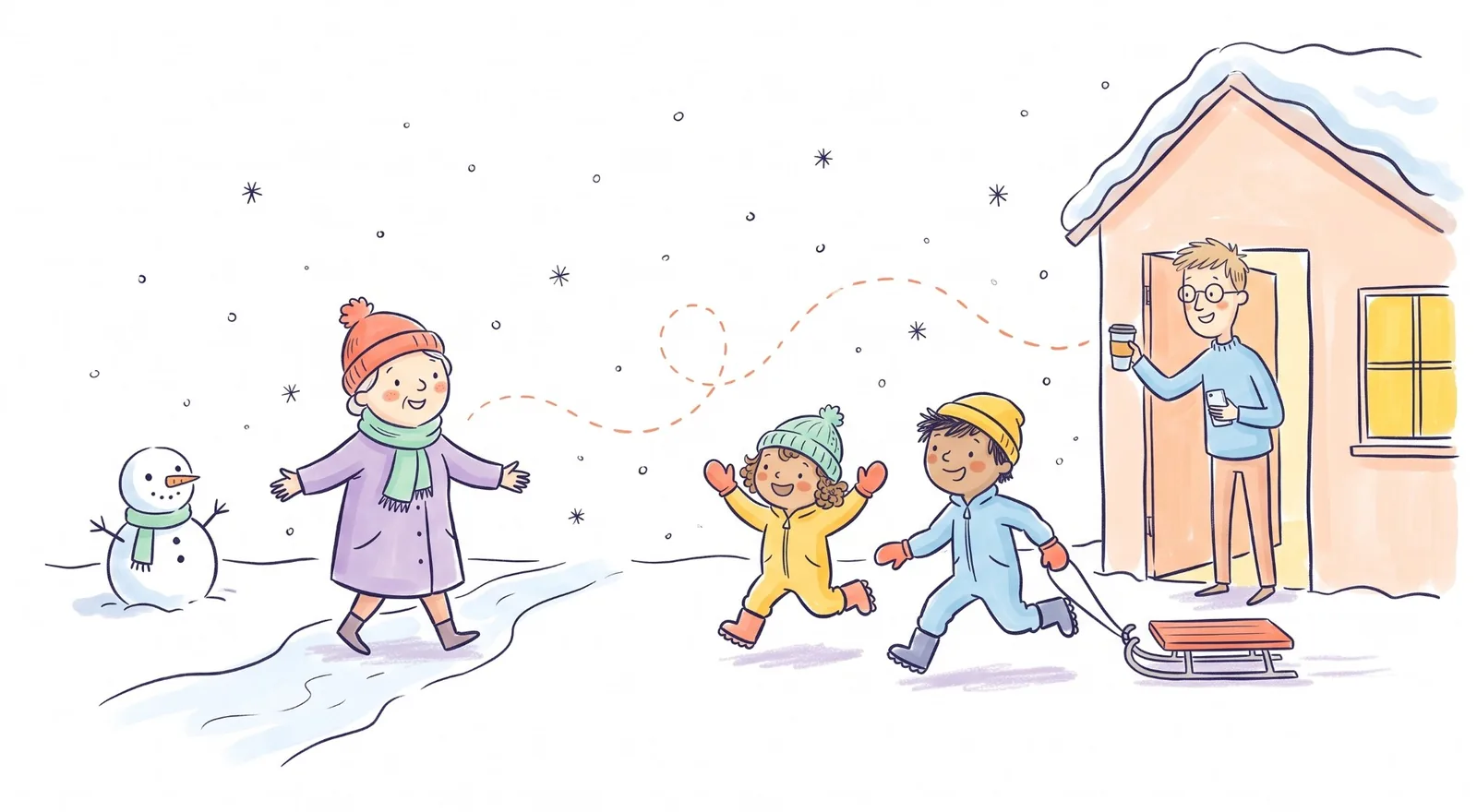
The text arrives at 5:52 a.m.: schools are closed today. You have a 9:00 meeting, your partner is on an early shift, and the sitter has two other families who just got the same text.
A snow day is harder than a sick day. There's no warning the night before, every family in town needs help at the same moment, and the roads that closed the school are the same roads Grandma would have to drive on. The families who handle it calmly aren't luckier. They decided who has the kids weeks earlier, when the sky was clear.
Here's how to build that plan in one evening.
When are snow days announced?
Most school districts decide early in the morning, after staff have driven the roads and checked the forecast, and tell families before the school day starts. In Nanaimo Ladysmith Public Schools on Vancouver Island, for example, a recommendation goes to the superintendent by 5:30 a.m. and families are told before 6:00 a.m. (SD68). Many US districts work to a similar early deadline.
Two things follow from that:
- You'll usually find out before 6 a.m., which is too late to start looking for help. The plan has to exist already.
- Check your own district's weather page now for its deadline, where it posts closures (website, text, app, local radio), and whether buses can be cancelled while schools stay open. Sign up for its alerts while you're there.
Why it needs a plan, not a favour
In two-thirds of US married-couple families with children, both parents work: 66.3% in 2025, according to the Bureau of Labor Statistics (BLS). In single-parent homes, there's nobody else to ask at all. So on a snow day most households have the same problem at the same time, and the people you'd normally call are being called by everyone else.
A plan solves that by deciding the order of who to ask in advance, so nobody spends the morning texting four people at once.
Who can watch the kids on a snow day?
| Option | Works best when | Set it up | Watch out for |
|---|---|---|---|
| A grandparent or relative | They live close enough to come on snowy roads, or you can drop the kids there | Ask now: "If school closes, could you take them?" | Icy driving for older relatives |
| Your regular sitter | They're free in the daytime | Ask if they'll take snow days and at what rate | They may have promised other families first |
| A swap with other families | Two or three families from the same school | Agree a rota: one parent has all the kids, and you take turns | Needs a clear order, or everybody assumes it's someone else's turn |
| A snow day or day camp | Your city's rec centre or a local club runs one | Find out now whether they do, and how you book | Spaces go fast when everyone gets the same text |
| Working from home | Older kids who can mostly entertain themselves | Ask your manager now what a snow day looks like for you | Hard with toddlers or with a full day of calls |
| An older sibling | The sibling is old enough and willing | Talk it through with them before it happens | Their own age and your local rules: see what to know about older siblings in charge |
| Home alone | Your child is old enough and ready | Check the rules where you live with our home alone age lookup | A long day alone is a different thing from an hour after school |
Most families need two of these: a first choice and a backup for when the first choice is snowed in too. The same thinking, stretched over two weeks, is our winter break childcare plan.
How to set up a snow day rotation with other families
A swap is the most reliable option for many families because it doesn't depend on one person's calendar. Here's how to make one work:
- Pick two or three families from the same school who live near each other.
- Agree the order in advance: Family A hosts the first snow day of the winter, Family B the second, and so on. If the host can't, it passes to the next.
- Agree the basics: what time drop-off is, who brings lunches, screen rules, and whether the host takes kids outside.
- Swap emergency details for every child, plus anything about allergies or medication.
- Decide who confirms that the swap is on. One message by 6:30 a.m. ("Snow day is on, kids to us by 8:00") beats a thread of maybes.
What if it's a remote learning day instead?
More schools now switch to online classes instead of closing. That changes school, not childcare: younger children still need an adult nearby to log on, stay on task and eat lunch.
Rules vary a lot by state. In 2025–26, according to researchers at the assessment nonprofit NWEA, four states and Washington, D.C. didn't count remote days toward instruction time at all, 23 states capped how many could count (typically three to five, and up to ten in a few), and the rest left it to districts or had no set limit (NWEA, 2026). Your district's weather page should say which kind of day it uses.
If your kids would be home on a remote day, plan it exactly like a snow day.
Can I take time off for a school closure?
It depends on where you work. A few examples:
- Ontario: most employees get up to three days of unpaid, job-protected family responsibility leave a year after two weeks on the job, for illness or an "urgent matter" that's unplanned or out of your control. The province's own example of an urgent matter is a babysitter calling in sick (Ontario). It doesn't mention snow days by name, so check with your employer.
- Federally regulated workplaces in Canada (banks, airlines, telecoms and others): up to five days of personal leave a year, the first three paid after three months on the job, including for urgent situations and for obligations related to the education of a family member under 18 (Government of Canada).
- The US: there's no federal law that gives parents time off when school closes for weather. Some states and cities have paid sick or family leave laws, and many employers have their own policies, so check your state's labour department and your handbook.
Wherever you are, the time to ask your manager what a snow day means for you is in November, not on the morning itself.
Can my child stay home alone on a snow day?
Maybe, but a snow day is long. A child who is fine alone for an hour after school may not be ready for eight hours, especially with no power, no school to go to and the roads too bad for you to get back quickly. Most guidelines also set shorter times for younger children. Look up the rule where you live with our home alone age by state and province, and read how old a child should be to stay home alone for what makes a child ready.
Keeping kids safe outside on a snow day
Whoever has the kids will want to send them outside at some point. The American Academy of Pediatrics' winter safety advice (HealthyChildren.org) is worth passing on:
- Dress them in several thin layers, and change wet clothes straight away.
- Avoid outdoor play when the temperature or wind chill is below −15°F (about −26°C).
- Children under 12 should always be supervised while sledding.
- Give them somewhere to warm up with regular indoor breaks.
- For frostbite, soak the area in warm, not hot, water for 20 to 30 minutes, and call a doctor.
The night-before checklist
When the forecast says snow, take ten minutes the night before:
- Sign up for, or check, your district's closure alerts.
- Message your first-choice helper: "Looks like snow. If school closes, are you still OK to take them?"
- Confirm your backup in case the first choice is snowed in too.
- Agree with your partner or co-parent who is staying home, who is driving, and who is working.
- Pack a bag for each child: snow clothes, spare socks, a lunch, chargers, anything for school work.
- Put the plan somewhere everyone involved can see it, not in your head.
Putting the plan where everyone can see it
A snow day plan only works if everyone in it knows their part by 6:30 a.m. That's the job Kid Pickup is built for:
- Ask for help once. Tap Request Help with a note ("Schools closed. Can anyone take Lily and Leo today?") and everyone who could go gets a "Can you help?" notification with an I'll do it button. The first yes puts their name on it, and everyone else can see it's covered.
- Call off what isn't happening. Call off today's school pickup with a reason like "Snow day", and the person who had it is told, so nobody drives to a closed school.
- One chat for the whole circle. The family chat includes Grandma, the other parent and the sitter, so the plan, the drop-off time and the packed lunches are in one place.
- If nobody has it, the app sends a nudge to the parents, so an open day doesn't go unnoticed.
Snow days will still happen at 5:52 a.m. But with the plan in one place, the first text you send can be "It's on, kids to Grandma's by 8", not "Does anyone know anyone?" Kid Pickup is on iPhone with a 14-day free trial, and grandparents and sitters never pay.
FAQ
What should working parents do on a snow day?
Have a plan before the first storm. Name a first and a backup adult who can take the kids, set up a rotation with two or three nearby families, find out what time off your job allows, and agree the night before who is staying home and who is working. Then confirm the plan with one message as soon as the closure is announced.
What time are snow days usually announced?
Most districts decide early in the morning after checking the roads, and tell families before the school day, often before 6 a.m. Check your own district's weather page for its deadline and how it posts closures, and sign up for its alerts.
Who can watch my kids on a snow day?
The usual options are a grandparent or relative, your regular sitter, a swap with other school families, a snow day or day camp if your city runs one, working from home if your kids are old enough, or an older sibling. Most families need a first choice and a backup.
Can I take a day off work when school is closed for snow?
It depends on where you work. Ontario gives most employees up to three unpaid days of family responsibility leave a year for urgent matters, and federally regulated employers in Canada give up to five days of personal leave, three of them paid. In the US there's no federal law for it, so check your state's rules and your employer's policy.
Is a remote learning day the same as a snow day for childcare?
For younger children, yes. Classes move online, but someone still needs to be home to help them log on, stay on task and eat lunch. Plan a remote learning day the same way as a snow day.