
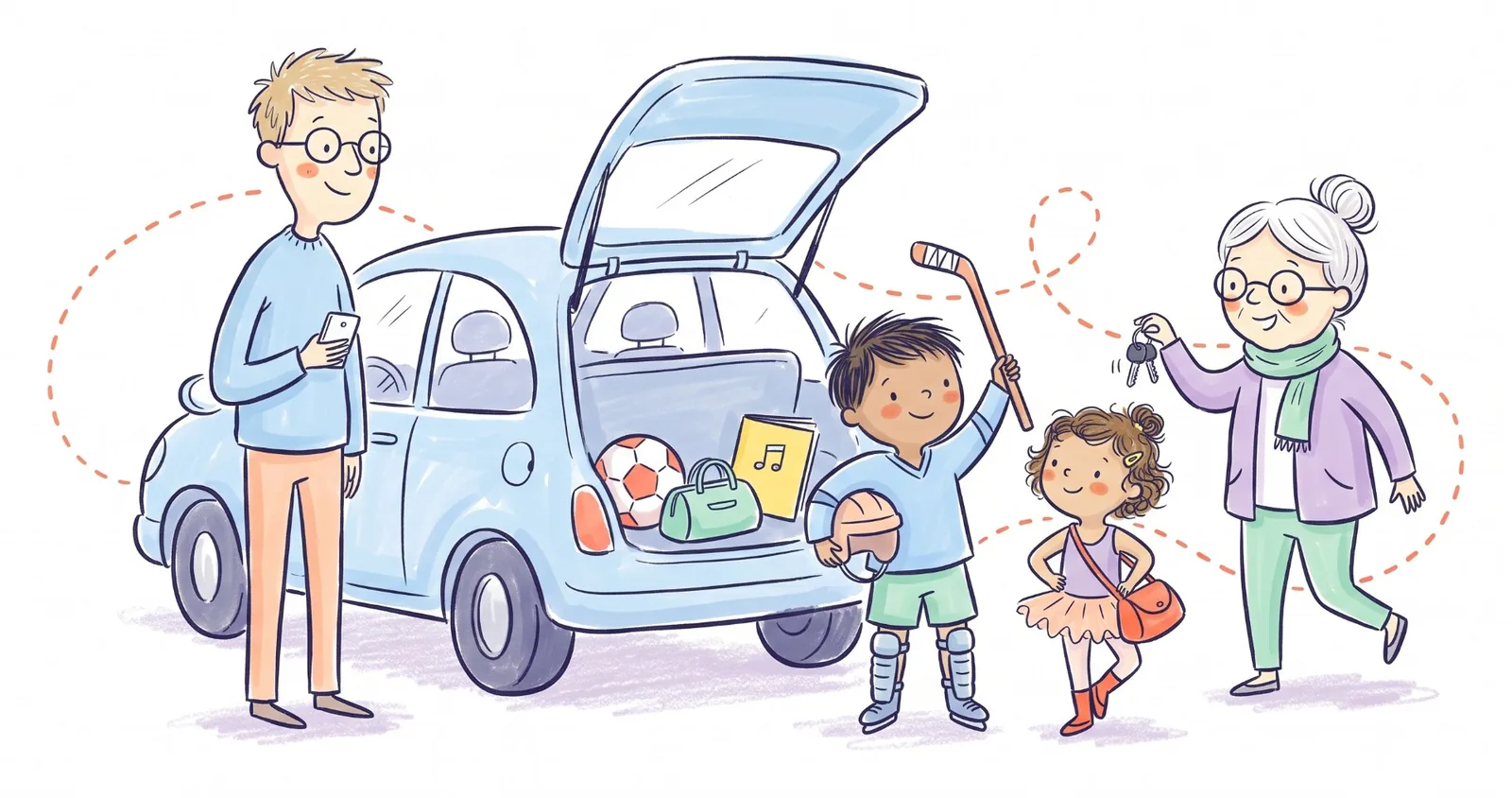
Monday is swim for one and piano for the other. Tuesday, hockey at 5:30 across town and dance at 5:45 the other way. Wednesday is somehow both. By the second week of winter registration, the activity schedule has stopped being a schedule and turned into a puzzle with two drivers and three kids.
Two questions tend to arrive together around now: how do we keep track of all this? and, a little quieter, is this too much? Both have better answers than most of what's out there, so this post takes them in that order.
How many activities is too many?
Less often than parents fear, going by the research. In a summary for the Society for Research in Child Development, Joseph Mahoney, Angel Harris and Jacquelynne Eccles found that young people spend an average of about five hours a week in organized activities, that only 3 to 6% spend 20 hours or more, and that worries about over-scheduling were "largely unfounded" (SRCD, 2006).
A later study followed 1,115 American teenagers into their early twenties. The more weekly hours they had spent in organized activities, the better they tended to be doing as young adults on flourishing, volunteering and education, and the researchers found no link between activity hours and distress or substance use. Even the small group doing 20 hours or more, about 6% of the sample, did no worse on those measures than kids who did nothing (Mahoney & Vest, Journal of Research on Adolescence, 2012).
So for most kids, two or three activities is not a problem in itself. What usually goes wrong is everything around the activities: sleep, homework, dinner, and the adults doing the driving.
The questions that actually decide it
Instead of counting activities, check what they're pushing out. The CDC recommends 9 to 12 hours of sleep a day for children aged 6 to 12, and 8 to 10 for teens aged 13 to 17 (CDC). A schedule that keeps a 10-year-old out until 8:30 three nights a week, with homework after, will run into that number quickly.
| Ask yourself | If the answer is no… |
|---|---|
| Is my child getting the sleep their age needs (9–12 hours from 6 to 12, 8–10 from 13 to 17)? | Something late in the week has to go, or move earlier |
| Is there an evening most weeks with nothing on? | Try to protect one before adding anything |
| Does homework get done without a fight at 9 p.m.? | Look at which nights the activities fall on |
| Do we eat together at least a few times a week? | Shift dinner, or drop a night |
| Does my child still want to go, most weeks? | Ask them, away from the car ride home |
| Can we cover every drive without someone leaving work early? | Line up a carpool or another driver first |
That last row is the one most families feel first. Parents of kids in sports say so too: in an August 2026 AP-Ipsos poll, 84% of sports parents called scheduling, logistics and the time commitment a challenge, more than the 73% who said the same about team fees (AP-Ipsos).
Keeping track of several kids' activities
The families who seem calm in November mostly do three things.
One calendar everyone can see. Paper on the fridge, a shared phone calendar, an app. It matters less which one than that there's only one, and that the other parent, the grandparents and the carpool can all see it. Two calendars always disagree by Thursday.
Each child gets a colour. Glancing at the week, you should be able to see at once that Wednesday is all orange.
Get the schedules in without typing them. Most teams now publish their season in TeamSnap, GameChanger, a club website or a Google calendar. Subscribe to it, or import it, rather than copying 40 dates by hand. When the coach moves a game, a subscribed calendar moves with it.
Two practices at the same time
It happens to every family with more than one child in activities. Sooner or later there's a Tuesday at 5:30 with two kids in two places.
Some ways through it:
- Carpool one of them. A family from the same team takes your child to practice, and you do the drive back, or swap weeks. Our carpool schedule guide covers how to set one up, and the free carpool rotation generator builds the rota for you.
- Split drop-off and pickup. One adult drops off both, the other collects both. It's often easier than each parent doing a full round trip.
- Ask a grandparent for the regular clash, not every week. "Could you do Tuesdays from January to March?" is an easier yes than an open-ended favour.
- Stagger the seasons. If two kids want winter sports, one might do spring instead. It's much easier to decide that at registration than in the middle of the season.
- Choose closer. When it's a choice between two clubs, the one ten minutes from home wins a lot of Tuesdays.
Every practice needs a driver's name
A calendar tells you a practice is happening. It doesn't tell you who's taking them, and that's the question that falls through: two parents each assuming the other has it, or nobody noticing that Thursday has no driver until 5:10.
The habit that fixes it is simple. On Sunday night, go through the week, and next to every drop-off and pickup write one name. Not "one of us". A name. Anything without a name gets sorted that night, while there's still time to ask Grandma or swap with another family.
Planning the winter season before it starts
Winter sports and rec-centre programs usually start registering in October and November, which makes now the time to decide how much the family can carry, while every option is still open.
- Write down every activity each child wants, with the days and times.
- Lay them on one week and look for clashes and late nights.
- Count the drives, both ways, and put a name on each one.
- Check the sleep line for each child's age.
- Talk to your kids about which ones matter most to them. If something has to go, it helps that they chose it.
- Book the carpool now, while other families are planning too.
Putting it into one app
Kid Pickup was built around the Sunday-night question of who's driving.
- Follow the team calendars. Paste a TeamSnap, GameChanger, school or Google Calendar link and new and moved dates come in on their own, about once an hour (how). For a schedule that only exists as a PDF or an email, paste it or take a photo and tick the dates you want (how).
- One name on every drive. The other parent, Grandma or the sitter taps I'll do it, or Can't make it, and everyone can see who's going.
- Split the halves. Choose "A different person for each" and one person does drop-off while another does pickup.
- Open drives get noticed. If nobody has taken one, the app sends the parents a nudge the day before and again on the day.
- Each child has their own colour on the calendar, and about a hundred activities each get a symbol, so a busy week is easy to read.
Grandparents and sitters don't pay for it, and the whole family can try it free for 14 days. Swim and hockey still clash at 5:30; at least now everyone knows who's driving where.
FAQ
How many extracurricular activities should a child do?
There's no single right number. Research summarized by the Society for Research in Child Development found the typical child spends about five hours a week in organized activities, and that most kids are not over-scheduled. A better test is whether your child still gets enough sleep, has time for homework and free time, and still wants to go.
Is 20 hours a week of activities too much?
Only a small share of kids do that much: about 3 to 6% in one research summary. A national study of teenagers found those doing 20 hours or more did as well on flourishing and education as other kids, and no worse on distress or substance use. Watch sleep, schoolwork and mood rather than the hours alone.
How do I keep track of multiple kids' activity schedules?
Use one shared calendar that every adult involved can see, give each child a colour, and subscribe to or import team schedules instead of typing them. Then put a named driver on every drop-off and pickup at the start of each week.
What do you do when two kids have activities at the same time?
Carpool one child with another family, split drop-off and pickup between two adults, ask a grandparent to cover the regular clash, stagger the kids' sports across seasons, or choose activities closer to home.
What are signs a child is doing too much?
Regularly getting less sleep than their age needs, homework pushed late into the night, no free evenings, meals always on the run, or a child who no longer wants to go. Any one of those is worth a conversation about what to keep.